
MEXC Referral Code 2026: mexc-cpdiscount
Register on MEXC with referral code mexc-cpdiscount for a 15% rebate on the trading fees you pay. It sits on top of the cheapest futures schedule on this page: maker orders are free and takers start at 0.02%.
mexc-cpdiscount Carried by the link above. MEXC does not attach a referrer retroactively, so the code has to be present in the invite field when the account is created.
Coinperps may earn a commission from partner links, at no extra cost to you. Offer terms are set by MEXC and can change. See how we test.
- How to claim it
- 01
Register with the code
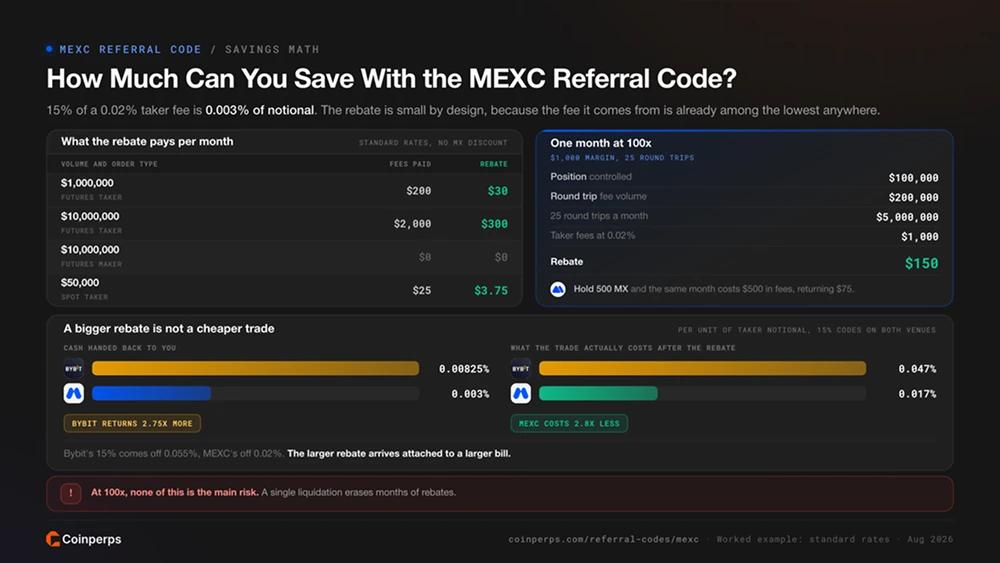
Open MEXC through the mexc-cpdiscount link so the invite code is attached before the account is created.
- 02
Fund the account
Deposit crypto. Identity verification is optional on MEXC, so you can move straight to funding if you prefer.
- 03
Trade and collect
The 15% rebate applies to the fees you pay, and maker orders on USDT-margined futures cost nothing to begin with.
- The MEXC referral code mexc-cpdiscount attaches a 15% rebate to the trading fees you pay on spot and futures.
- MEXC has the cheapest futures schedule here. Maker orders are free and takers start at 0.02%, so a maker-heavy strategy costs close to nothing before the rebate applies.
- The trade-off is regulation. MEXC carries the weakest regulatory position of the venues covered, which is reflected in its Coinperps score.
What Is the MEXC Referral Code?
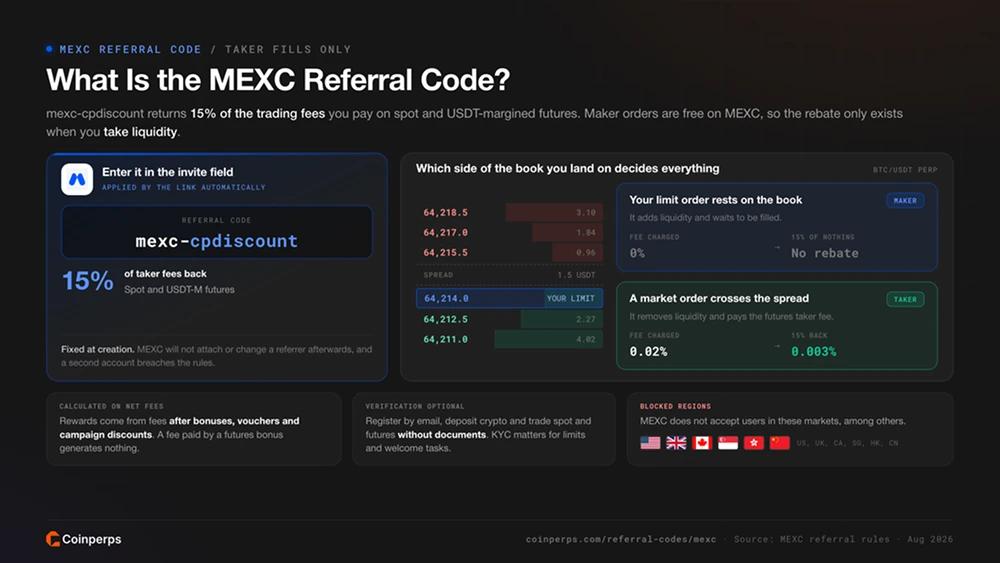
The MEXC referral code mexc-cpdiscount links a new account to a 15% rebate on trading fees paid across spot and USDT-margined futures. The code must be entered in the invite field during registration. The link at the top of this page applies it automatically.
Maker orders cost nothing on MEXC spot and futures markets, so the rebate only applies when you take liquidity. Someone trading exclusively with resting limit orders pays no fee and receives no rebate. A futures trader using market orders pays 0.02% and gets 0.003% of notional back.
Under MEXC's referral rules, rewards are calculated from the invitee's net fees after bonuses, vouchers and campaign discounts. Fees covered by a futures bonus generate no reward. Neither do fees removed through a zero-fee promotion.
Two account rules determine how the offer works.
- Verification is optional for trading: You can register with an email address, deposit crypto and trade spot and futures without documents. Verification becomes relevant for withdrawal limits and welcome tasks.
- The referral is fixed at creation: MEXC will not attach or change a referrer after registration. Adding a code later has no effect, while opening a second account breaches the rules.
Regional access is more limited than the marketing suggests. MEXC blocks users from the United States, the United Kingdom, Canada, Singapore, Hong Kong and mainland China, among other locations. Our MEXC restricted countries guide tracks the list as it changes.
How to Use the MEXC Referral Code (Step-by-Step)
Verification is not required before trading. The main point to check is whether the code appears in the form before you submit it.
- Open the mexc-cpdiscount link: The button at the top of this page opens MEXC's sign-up form with the invite code applied. If the field is blank, enter mexc-cpdiscount before continuing.
- Register with email or phone: Create a password and confirm the verification message. MEXC does not ask for identity documents at this stage.
- Secure the account: Turn on two-factor authentication and set up a withdrawal whitelist. These measures reduce the likelihood of a later risk control review.
- Deposit crypto: MEXC does not charge for crypto deposits, and USDT on TRC-20 is the cheapest common route. P2P fiat purchases require verification, making crypto the direct option for unverified users.
- Trade futures or spot: MEXC calculates the 15% rebate from the taker fees paid on each fill. Maker orders remain free and produce no rebate.
- Decide on verification: Complete Primary or Advanced KYC if you need welcome bonus tasks, increased withdrawal limits or API access. Verification does not affect the referral.
Once you have traded, open the Referral or Rewards section of your account. The fee return should appear against each taker fill. If it does not, the code may not have attached during registration.
Why Zero Maker Fees Change What the Rebate Is Worth
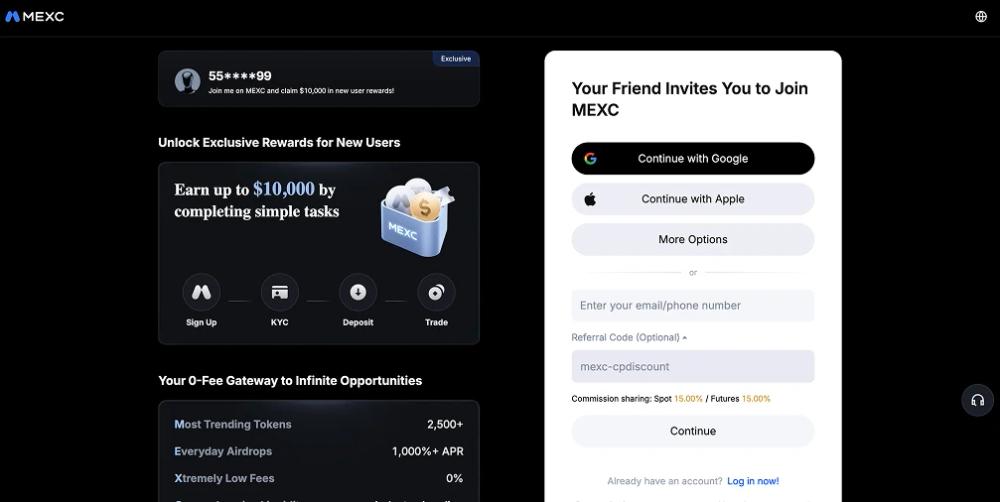
Because the rebate is a percentage of the underlying fee, MEXC's fee schedule determines its maximum value. The standard rates in MEXC's fee documentation are shown below.
Market | Maker | Taker | Taker with MX deduction (20% off) | Taker with 500+ MX held (50% off) |
|---|---|---|---|---|
Spot | 0% | 0.05% | 0.04% | 0.025% |
USDT-M futures | 0% | 0.02% | 0.016% | 0.01% |
MX token discounts are the main way to reduce the headline rates, but they also lower the fee base used to calculate the rebate.
- MX deduction: Enable this setting to pay fees in MX at a 20% discount. MEXC then calculates the 15% rebate from the reduced fee.
- 500 MX holding: Holding at least 500 MX for 24 hours qualifies for a 50% discount, with eligibility confirmed through random daily snapshots. MEXC applies the larger of the two discounts rather than combining them.
- Regional schedules: Some countries have moved to futures rates of 0.01% for makers and 0.04% for takers. The fee page in your account provides the schedule that applies to you.
- API orders: Futures orders placed through the API follow a separate, substantially higher schedule. MEXC's own review of its pricing quotes 0.06% for makers and 0.08% for takers. MX discounts are excluded, and KYC is required to obtain API keys.
A bot trader expecting to pay the headline 0.02% rate instead pays four times as much. Receiving a 15% rebate on that larger fee offers limited consolation. Our lowest fee perpetual exchanges ranking compares MEXC's manual and API rates with competing platforms. The maker vs taker fees guide explains how to keep orders on the maker side.
How Much Can You Save With the MEXC Referral Code?
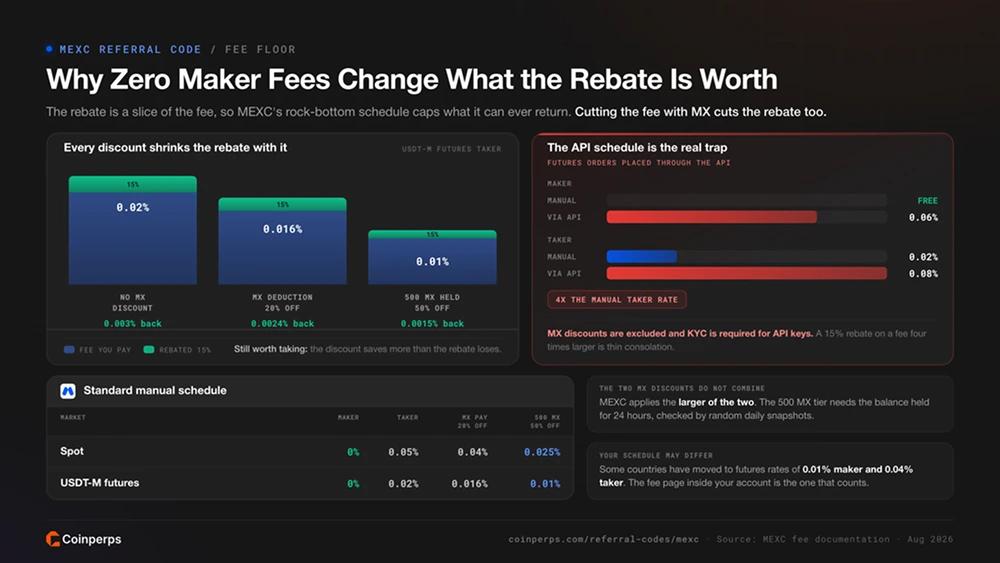
At the standard futures taker rate, 15% of 0.02% equals 0.003% of notional. Meaningful savings therefore depend on trading frequency and leverage. The examples below assume no MX discount.
- $1 million in taker volume: Fees of $200, rebate of $30.
- $10 million in taker volume: Fees of $2,000, rebate of $300.
- $10 million in maker volume: Fees of $0, rebate of $0.
- $50,000 in spot taker volume: Fees of $25, rebate of $3.75.
With 100x leverage, $1,000 of margin controls a $100,000 position. Each round trip creates $200,000 in fee volume. Completing 25 round trips per month produces $5 million in volume, resulting in $1,000 of taker fees and a $150 rebate. If the trader also qualifies for the 500 MX discount, the fee falls to $500 and the rebate to $75.
The comparison with other exchanges works in both directions. Bybit's 15% rebate on a 0.055% taker fee returns 0.00825% of notional, almost three times the MEXC amount. Even after the rebate, however, the Bybit trader pays 0.047% net compared with 0.017% on MEXC.
A lower base fee reduces the rebate in dollar terms but leaves more money in the account. Our Bybit vs MEXC and Binance vs MEXC comparisons examine the complete fee ladders.
At 100x leverage, the fee saving is minor compared with the risk of liquidation. Read our guide to avoiding auto-deleveraging and check the live funding rates tracker before sizing a position at that level.
Welcome Rewards, Verification and Withdrawal Limits
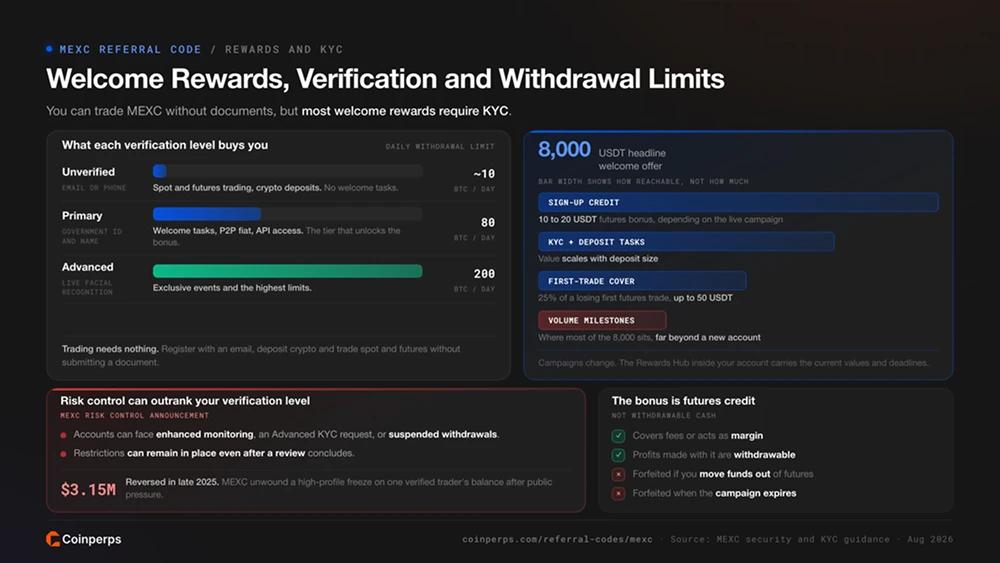
MEXC's welcome offer of up to 8,000 USDT consists of several tasks, one of which is identity verification. Unverified accounts can trade freely but cannot claim most new-user rewards. Whether you complete KYC therefore determines whether you can access the bonus.
MEXC's security and KYC guidance describes the three account tiers.
Level | What you provide | Daily withdrawal limit | What it unlocks |
|---|---|---|---|
Unverified | Email or phone | Around 10 BTC in most regions | Spot and futures trading, crypto deposits |
Primary | Government ID and name | 80 BTC | Welcome tasks, P2P fiat, API access |
Advanced | Live facial recognition | 200 BTC | Exclusive events, higher limits |
The rewards follow a familiar structure.
- Sign-up credit: Registration often provides a small futures bonus worth 10 to 20 USDT, depending on the active campaign.
- Verification and deposit tasks: Completing KYC and making an initial deposit release additional rewards, with their value increasing according to deposit size.
- First-trade loss cover: Recent campaigns have offered to cover 25% of a losing first futures trade, up to 50 USDT. MEXC pays this protection as futures bonus rather than withdrawable cash.
- Trading milestones: Reaching the larger amounts included in the 8,000 USDT headline requires futures volume well beyond a new account's first trade.
The bonus functions as futures credit. It can cover fees or serve as margin, and profits earned from it are withdrawable. Moving funds out of the futures account or allowing the campaign to expire forfeits the bonus balance. Check the current Rewards Hub terms before depending on it.
MEXC's risk control system may place an account under enhanced monitoring, request Advanced verification or suspend withdrawals after flagging activity. The exchange's risk control announcement confirms that restrictions can remain in place even after review.
In late 2025, MEXC reversed a high-profile freeze involving roughly $3.15 million held by one verified trader following public pressure. Practical precautions include trading from a fresh account and avoiding order patterns that resemble bot activity. Deposits should also come from clean sources.
Zero-Fee Campaigns and Stock Futures That Stack With the Code
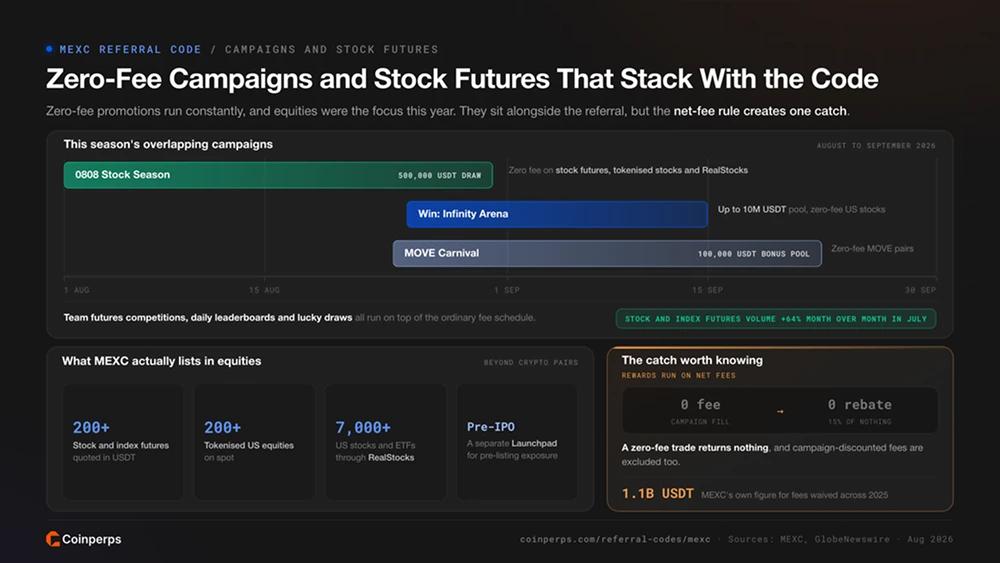
Zero-fee offers are a recurring part of MEXC's promotional calendar, with equities becoming the focus this year. These campaigns operate alongside the referral rebate, although the net-fee rule creates an important limitation.
- Win: Infinity Arena: A team futures competition running from 25 August to 15 September, featuring a tiered prize pool of up to 10 million USDT. It also includes zero-fee US stock trading and daily volume leaderboards, as reported by GlobeNewswire. MEXC says its stock and index futures volume increased 64% month over month in July.
- 0808 Stock Season: Held each August, MEXC's new annual brand event combined zero-fee trading across stock futures, tokenised stocks and RealStocks. A 500,000 USDT lucky draw pool was also available.
- MOVE Carnival: A month-long event ending on 23 September, offering zero-fee MOVE pairs and a 100,000 USDT futures bonus pool for new users who complete a spot trading task.
- Stock product range: MEXC offers more than 200 stock and index futures alongside over 200 tokenised US equities. RealStocks provides access to more than 7,000 US stocks and ETFs, while the platform also operates a Pre-IPO Launchpad. Our best TradFi perpetual exchanges guide compares this range with Bybit and Hyperliquid.
If a trade carries no fee, there is nothing to rebate. The referral produces no return on fills made during a zero-fee campaign. MEXC's rules also exclude campaign-discounted fees from referral commission. For most users, the code provides value through ordinary taker volume outside these promotions.
MEXC reports that its zero-fee strategy saved users more than 1.1 billion USDT during 2025. Although this is a company figure, it shows the importance of zero-fee pricing to the exchange's strategy. Our best crypto exchange VIP programs roundup covers the Alpha Trader tier for high-volume accounts.
Earning From Your Own MEXC Referral Code
Any account can invite new users through the Referral page. MEXC's standard terms are more generous than those of most centralised exchanges. According to its referral guide, the base commission is 40% of spot and futures fees, increasing to 50% in certain regions.
- Commission base: Rewards are calculated from the net fees paid by invitees after bonuses, vouchers and other deductions. Deposit and withdrawal charges are excluded.
- Duration: Commission continues for 1,080 days from the date each invitee registers.
- Currency: MEXC pays commission in the currency used by the invitee for fees. If an invitee pays with MX, the referrer receives MX.
- Affiliate tier: Creators with an audience can apply for the affiliate programme. Rates reach up to 70%, with an additional 10% share of sub-affiliate commission.
- Enforcement: Duplicate accounts and self-referrals invalidate the relationship and cause accrued commission to be forfeited.
The 15% rebate attached to mexc-cpdiscount is funded from the referrer's share. If an invitee pays $2,000 in monthly fees, they receive $300 back. A standard referrer then earns 40% of the remaining $1,700, equal to $680. Volume traded under zero-fee campaigns produces no reward for either party, which explains why MEXC referrers tend to promote futures rather than promotional spot pairs.
Bottom Line
MEXC referral code mexc-cpdiscount returns 15% of the taker fees paid on spot and futures. Maker orders are already free under the standard schedule, while futures takers pay 0.02%. The saving on an individual trade is modest, but the code costs nothing to use and remains attached for the life of the account.
MEXC's main attractions are its fee floor, 200x leverage ceiling and broad selection of listed assets. Users can also trade without submitting documents. In return, the exchange has a regulatory position that gives it the weakest rating among the venues covered here. Its risk control system has previously frozen verified accounts, and automated traders face an API fee schedule that quietly charges four times the standard futures taker rate.
For traders who prioritise low fees over licensing, our Gate.io referral code and Bitget referral code pages cover the closest alternatives. The Gate.io vs MEXC comparison places the two nearest peers side by side. Those seeking a no-KYC option with an on-chain settlement layer can review the different trade-off explained on our Hyperliquid referral code page.