Best USDC Margined Perpetual Exchanges (2026)
Explore the top USDC perpetual futures exchanges for 2026, ranked by fees, leverage, liquidity, supported markets and stablecoin margin features.

Disclosure: Coinperps may earn a commission from partner links, at no extra cost to you. Reviews are based on independent testing — see how we test.
- USDC-margined perpetuals are linear contracts where margin, profit, loss and funding all settle in Circle's fully reserved, monthly-attested dollar stablecoin.
- Our 2026 top picks are Bybit, Binance, Hyperliquid, MEXC, BingX and Coinbase International, with each offering a different balance of fees, leverage and regional access.
- 2026 brought deeper USDC incentives, from Binance's $100 million Circle stake and Bybit's dedicated USDC fee group to Hyperliquid's USDC yield-sharing model.

Bybit
Bybit, founded in 2018 and headquartered in Dubai, is the world’s second-largest exchange by volume, serving 60 million users with 1,800+ assets and over $11 billion in daily trading.
Features
Fees
Regulation
Overall Rating
Top USDC Margined Perpetual Exchanges in 2026
Our shortlist combines hands-on account testing with live market data from CoinGecko, CoinMarketCap and DefiLlama. We checked derivatives open interest, perpetual volume and listing depth before deciding whether each venue merited its position.
Two changes are especially notable this year. Hyperliquid and Coinbase International replace Bullish and Phemex. Hyperliquid now ranks second for open interest on CoinGecko, while Coinbase has expanded its USDC-settled product suite. Bybit remains first because of its dedicated USDC infrastructure.
Exchange | USDC Markets | Maker Fee | Taker Fee | Max Leverage | Key Nuance |
|---|---|---|---|---|---|
80+ | 0.02% | 0.055% | 100x | Dedicated USDC fee group with VIP taker cuts | |
100+ | 0% | 0.04% | 125x | Separate, cheaper USDC-M fee schedule | |
300+ | 0.015% | 0.045% | 40x | Native USDC collateral on an on-chain order book | |
100+ | 0% | 0.02% | 125x | Widest USDC-margined altcoin selection | |
40+ | 0.02% | 0.05% | 125x | Copy trading plus multi-asset margin | |
180+ | 0% | 0–0.03% | 50x | BMA-licensed, zero-fee pricing in select regions |
1. Bybit
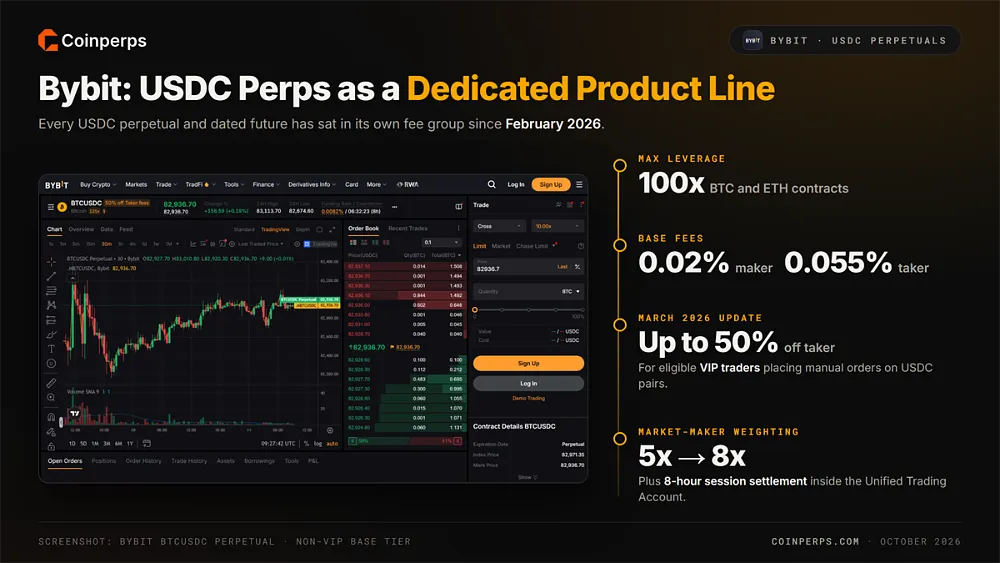
Bybit keeps the top spot because USDC perpetuals are treated as a distinct product line rather than an add-on. Since February 2026, every USDC perpetual and dated future has sat inside a dedicated USDC fee group, with consistent risk parameters and up to 100x leverage on BTC and ETH contracts.
A March 2026 update reduced taker fees on USDC pairs by up to 50% for eligible VIP traders placing manual orders. It also increased the market-maker weighting for USDC books from 5x to 8x. Non-VIP traders still pay 0.02% maker and 0.055% taker, making Bybit VIP tiers more relevant for active accounts.
Within the Unified Trading Account, USDC can margin spot, options and perpetuals together. Unrealized gains become realized USDC through 8-hour session settlement. We recommend Bybit for hedgers combining options with perps because portfolio margin recognizes offsetting risk and can reduce collateral requirements for balanced books.
Pros
- Dedicated USDC fee group keeps risk limits consistent across every contract.
- VIP traders receive up to 50% taker discounts on USDC pairs.
- Portfolio margin offsets hedged perpetual and options exposure in one account.
Cons
- Base 0.055% taker fee is higher than Binance's USDC-M schedule.
- USDC futures require upgrading to the Unified Trading Account first.
- Altcoin USDC books remain thinner than equivalent USDT-margined markets.
2. Binance
Binance remains the deepest venue for USDC-margined contracts. It leads CoinMarketCap's derivatives ranking with more than $33 billion in open interest across all markets. USDC-M perpetuals offer up to 125x leverage on Bitcoin and Ether, while major pairs retain tight spreads even through highly volatile sessions.
Pricing is a major advantage. Binance uses a separate USDC-M schedule with 0% maker and 0.04% taker fees at the base tier, below its own USDT-M rates. Paying in BNB cuts costs further. Our Bybit vs Binance fee comparison shows how both schedules change as volume rises.
Its stablecoin relationship deepened in September 2026 when Binance bought a $100 million stake in Circle. The five-year agreement is designed to promote USDC across the platform. Multi-Assets Mode also allows BTC or BNB to back USDC positions, avoiding a forced conversion before trading.
Pros
- Base USDC-M fees undercut most centralized competitors on both sides.
- 125x leverage and deep books on BTC and ETH USDC pairs.
- Multi-Assets Mode accepts BTC and BNB as USDC position collateral.
Cons
- Futures access is restricted in several jurisdictions, including the US.
- Smaller USDC altcoin pairs show wider spreads than USDT equivalents.
- Interface complexity can overwhelm newer traders compared with simpler apps.

3. Hyperliquid
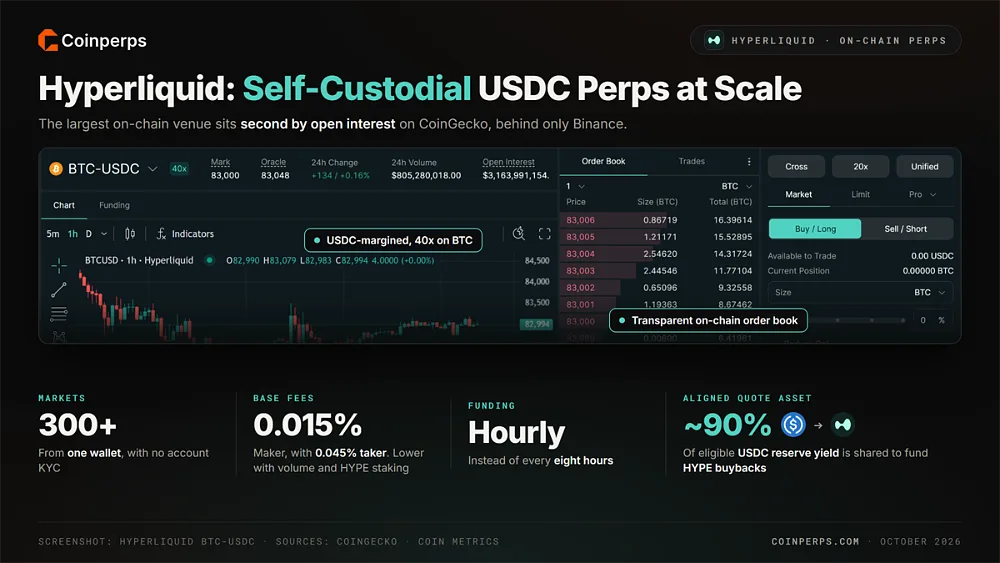
Hyperliquid is the largest on-chain venue and sits second on CoinGecko's derivatives table by open interest, behind only Binance. Its core perpetuals are margined and settled in USDC, letting traders fund one self-custodial wallet and access more than 300 markets without completing KYC.
USDC became even more important to the platform in 2026. Native Markets sunset its USDH stablecoin in May, after which USDC became Hyperliquid's Aligned Quote Asset. Native minting made the Arbitrum bridge optional, while roughly 90% of eligible reserve yield is shared with the protocol to fund HYPE buybacks, according to Coin Metrics.
Base fees begin at 0.015% maker and 0.045% taker, then fall with higher volume and HYPE staking. BTC leverage reaches 40x. Funding settles hourly instead of every eight hours. Our Hyperliquid fees guide explains the discounts, while the USDC deposit walkthrough covers lower-cost funding routes.
Pros
- Self-custodial trading with USDC collateral and no account KYC requirement.
- Transparent on-chain order book with deep BTC, ETH and HYPE liquidity.
- HIP-3 markets add commodity, index and equity perpetual exposure.
Cons
- Maximum 40x leverage sits well below centralized exchange limits.
- Hourly funding can swing sharply, adding cost volatility to positions.
- Unavailable to US persons and several other jurisdictions.
4. MEXC
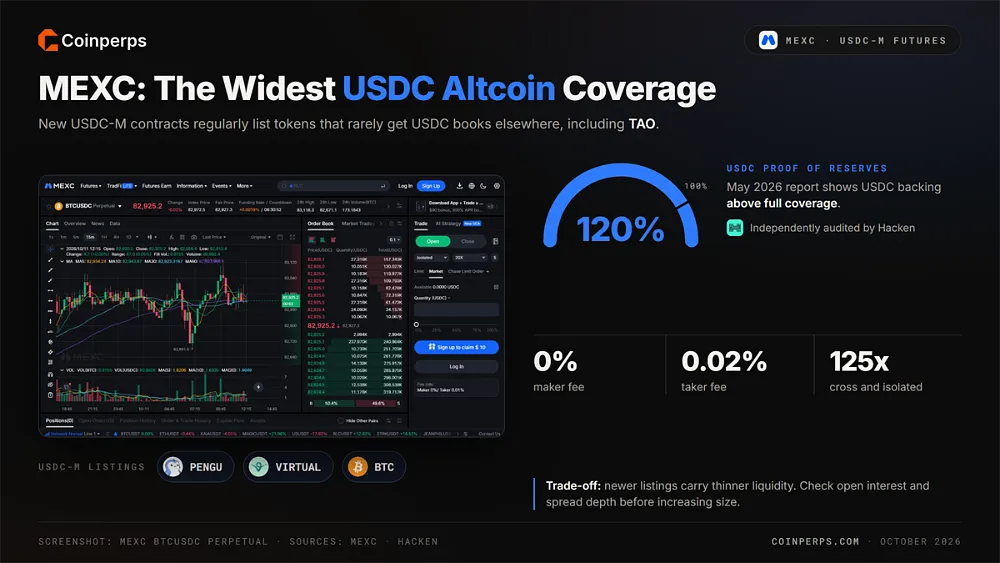
MEXC is seventh on CoinMarketCap's derivatives ranking but stands out for USDC altcoin coverage. New USDC-M contracts frequently include tokens such as PENGU, TAO and VIRTUAL, which rarely receive USDC books elsewhere. Launches generally support 125x leverage with both cross and isolated margin.
Low fees are the main attraction. Standard futures pricing is 0% maker and 0.02% taker, with selected USDC-M pairs periodically included in fully fee-free campaigns. MEXC also released a May 2026 proof of reserves showing USDC backing at 120%, independently audited by security firm Hacken.
We recommend MEXC for speculative traders seeking altcoin exposure settled in USDC instead of USDT. The trade-off is thinner liquidity on newer listings. Check open interest and spread depth before increasing size, and review the MEXC restricted countries list, as derivatives are unavailable in several regions.
Pros
- Broadest selection of small-cap tokens with USDC-margined perpetual contracts.
- 0% maker pricing and recurring zero-fee events lower execution costs.
- Monthly proof of reserves shows USDC backing above full coverage.
Cons
- Niche USDC listings often suffer slippage from low open interest.
- KYC-light accounts face strict withdrawal limits and feature restrictions.
- Charting and institutional execution tools trail larger centralized competitors.
5. BingX
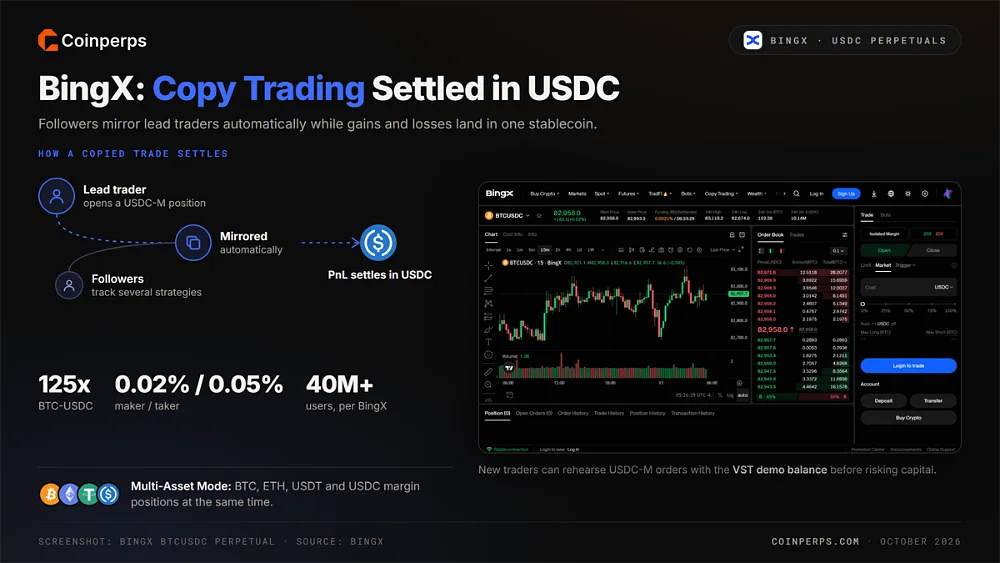
BingX ranks tenth on CoinMarketCap's derivatives table and is our strongest choice for traders combining USDC margin with copy trading. Followers can automatically mirror lead traders while gains and losses settle in USDC, which keeps performance easier to track across several strategies.
BTC-USDC contracts support up to 125x leverage. The platform's 2026 Multi-Asset Mode also allows BTC, ETH, USDT and USDC to margin positions at the same time. Standard fees are 0.02% maker and 0.05% taker, competitive overall but still above Binance's dedicated USDC-M pricing and MEXC's zero-maker rate.
According to BingX, the platform now serves more than 40 million users across over 1,100 trading pairs. New traders can use its VST demo balance to practice USDC-M orders without risking capital. Availability still varies, so review the BingX restricted countries list before opening an account.
Pros
- Copy trading lets followers mirror USDC-margined strategies automatically.
- Multi-Asset Mode accepts BTC, ETH, USDT and USDC as margin.
- VST demo funds allow risk-free practice before trading real USDC.
Cons
- USDC pair selection is far narrower than BingX's USDT-margined lineup.
- Base taker fee of 0.05% exceeds Binance's USDC-M rate.
- Open interest trails top-five venues, widening spreads during volatility.
6. Coinbase International
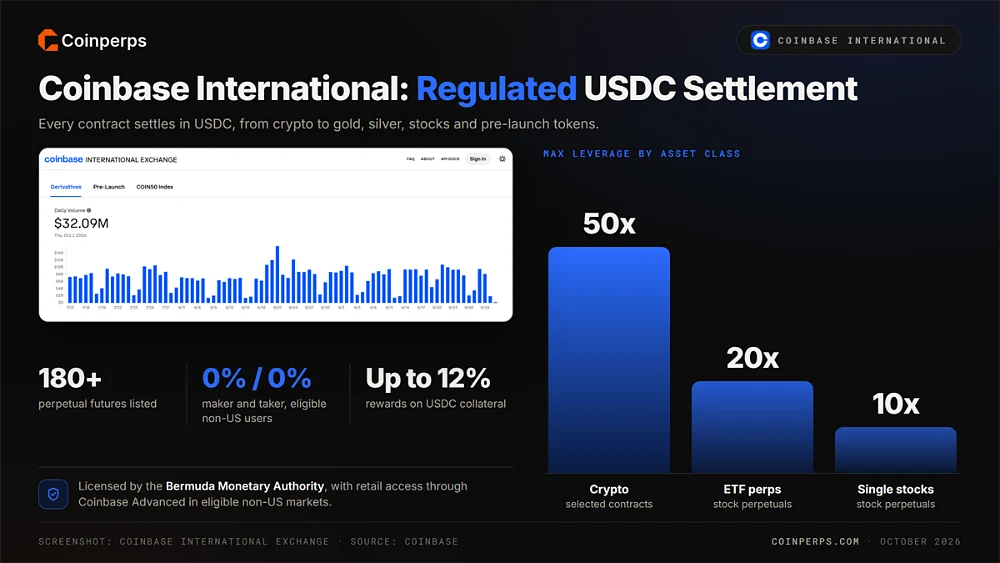
Coinbase International Exchange settles every contract in USDC and operates under a Bermuda Monetary Authority license, making it the most regulated option in this ranking. More than 180 perpetual futures are listed, including stock perpetuals and pre-launch tokens, with retail access through Coinbase Advanced in eligible non-US markets.
USDC settlement now extends beyond crypto. Gold and silver perpetuals arrived in May 2026, while stock perpetuals provide up to 10x leverage on single names and 20x on ETFs. Coinbase says eligible retail traders can use up to 50x leverage on selected crypto contracts.
Pricing can be especially aggressive. Eligible non-US users are offered zero maker and zero taker fees on perpetuals, and the platform advertises rewards of up to 12% on USDC held as derivatives collateral. Because eligibility and rates differ by jurisdiction, check the Coinbase perpetuals restricted countries guide first.
Pros
- BMA-regulated venue with USDC-denominated insurance fund and liquidity support.
- USDC settlement spans crypto, stock, commodity and pre-launch perpetuals.
- Rewards on USDC collateral offset part of holding costs.
Cons
- Unavailable to US residents and restricted across many jurisdictions.
- Altcoin coverage is narrower than MEXC, BingX or Binance.
- Institutional onboarding requires extensive documentation and eligibility checks.
What is USDC?
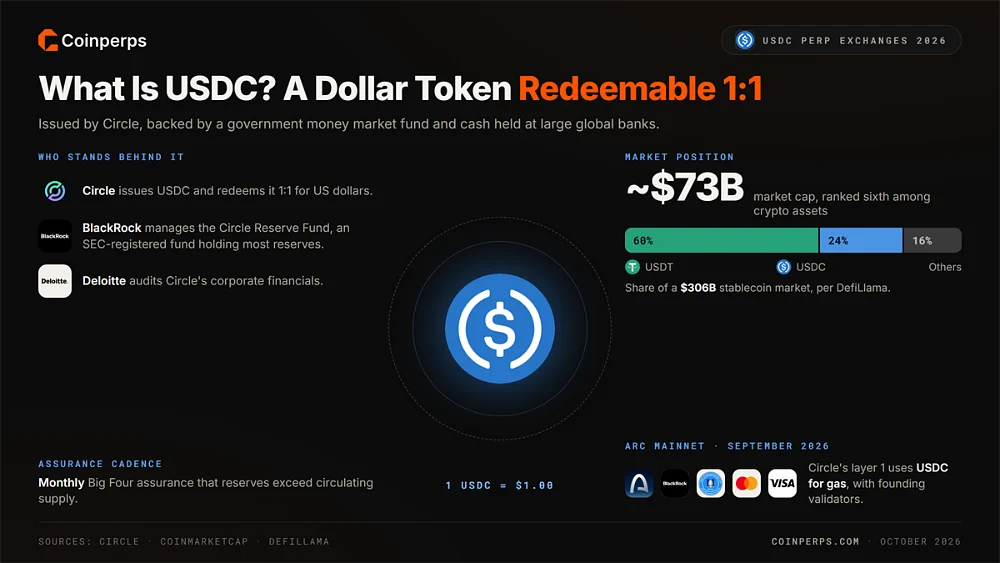
USDC is a dollar-pegged stablecoin issued by Circle and redeemable 1:1 for US dollars. Most of its reserves are held in the Circle Reserve Fund, an SEC-registered government money market fund managed by BlackRock. The remainder is kept as cash at large global banks, according to Circle's transparency page.
On CoinMarketCap, USDC has a market capitalization of roughly $73 billion and ranks sixth among all crypto assets. DefiLlama puts its share at about 24% of a $306 billion stablecoin market. USDT remains dominant at roughly 60%, helping explain the deeper liquidity still found in many USDT pairs.
A Big Four accounting firm provides monthly assurance that reserves exceed circulating supply, while Deloitte audits Circle's corporate financials. In September 2026, Circle also launched its Arc layer-1 mainnet, which uses USDC for gas. BlackRock, DTCC, Mastercard and Visa are among its founding validators.
How Do USDC-Margined Perpetual Exchanges Work?
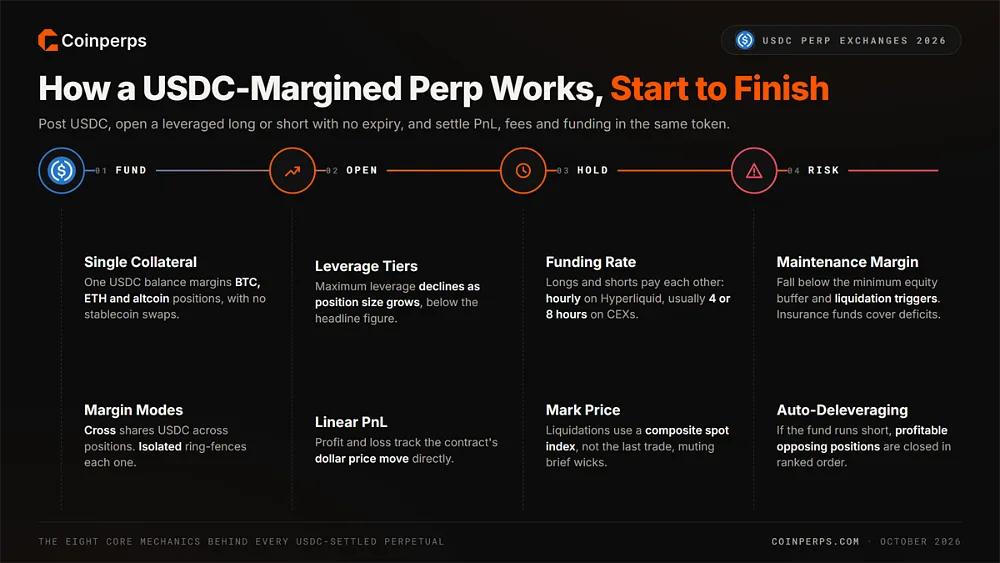
USDC-margined perpetual exchanges allow traders to post USDC as collateral and open leveraged long or short positions without an expiry date. Profit, loss, trading fees and funding payments are all settled in the same audited dollar stablecoin.
The core mechanics behind every USDC-settled perpetual contract include:
- Linear PnL: Profit and loss change directly with the contract's dollar price movement, unlike inverse contracts, where returns also depend on the value of the underlying coin.
- Single Collateral: One USDC balance can margin Bitcoin, Ether and altcoin positions, avoiding the need to hold each underlying asset or swap between stablecoins before trading.
- Funding Rate: Periodic payments between long and short traders keep perpetual prices close to spot, settling hourly on Hyperliquid and usually every four or eight hours on centralized exchanges.
- Mark Price: Liquidations are based on a composite index of external spot prices instead of the latest trade, reducing the effect of brief wicks or manipulated prints.
- Margin Modes: Cross margin shares available USDC among open positions, while isolated margin ring-fences collateral so one liquidation cannot consume the rest of the account.
- Leverage Tiers: Maximum leverage declines as position size increases, meaning a large BTC-USDC trade may have a much lower ceiling than the headline maximum.
- Maintenance Margin: An account must maintain a minimum equity buffer against open positions. Falling below that level triggers automatic liquidation, with exchange insurance funds covering any remaining deficit.
- Auto-Deleveraging: If an insurance fund cannot absorb a bankrupt position, the engine closes profitable opposing positions in ranked order, creating a risk that highly leveraged winners should monitor.
USDC vs USDT Margined Perpetuals
Both stablecoins provide linear settlement, but their reserve disclosures, regulatory positions, liquidity depth and fee incentives differ in 2026. Those differences can materially affect which margin currency works best for a particular strategy, account size or jurisdiction.
1. Reserves and Regulatory Standing
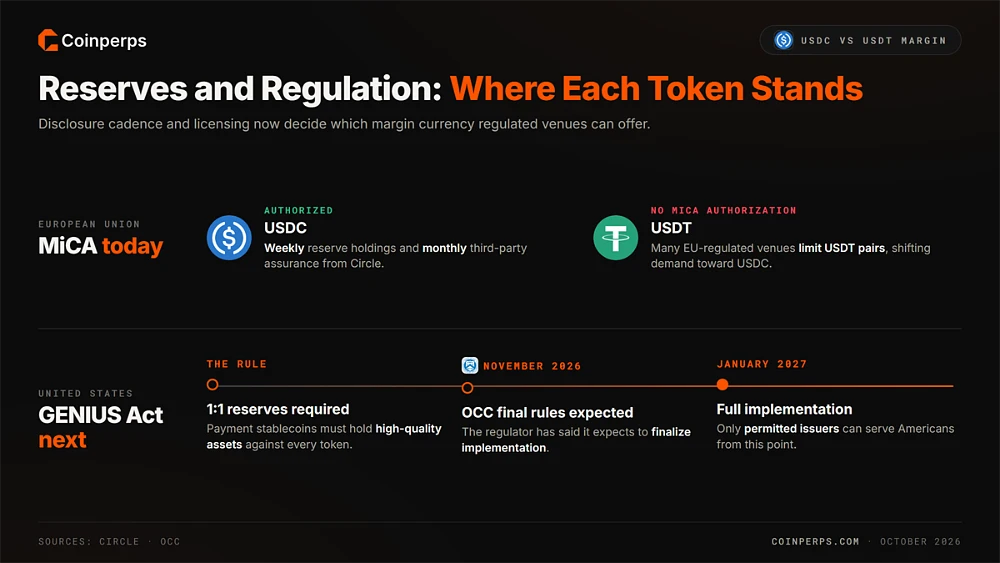
Circle publishes reserve holdings weekly and provides monthly third-party assurance. USDC is also authorized for use across the European Union under MiCA. USDT does not have MiCA authorization, so many EU-regulated venues limit USDT pairs for European customers, shifting some spot and derivatives demand toward USDC.
In the United States, the GENIUS Act requires payment stablecoins to maintain 1:1 reserves in high-quality assets. The OCC has said it expects to finalize implementing rules by November 2026. Full implementation is scheduled for January 2027, after which only permitted issuers can serve Americans.
2. Liquidity and Market Depth
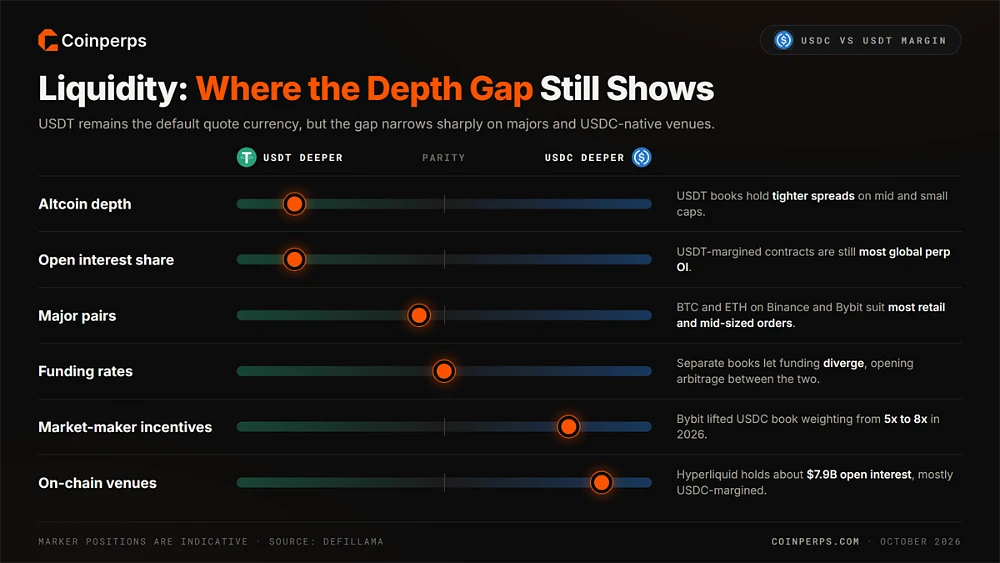
USDT is still the default quote currency across most perpetual markets. On major assets, however, the liquidity difference is much smaller, particularly at venues where USDC is native collateral rather than a secondary settlement choice.
Key liquidity differences traders notice between the two margin types:
- Altcoin Depth: USDT books generally maintain tighter spreads on mid- and small-cap tokens, meaning USDC traders may face more slippage on speculative altcoin entries.
- Major Pairs: BTC and ETH USDC contracts on Binance and Bybit are deep enough for most retail and mid-sized orders, reducing the practical difference from USDT.
- On-Chain Venues: Hyperliquid has about $7.9 billion in open interest on DefiLlama, mostly USDC-margined, making it the deepest USDC-native perpetual venue outside the major centralized exchanges.
- Funding Divergence: Because the contracts trade on separate order books, USDC and USDT funding can diverge and create funding rate arbitrage opportunities for offsetting positions.
- Market Makers: Bybit increased the market-maker weighting for USDC books from 5x to 8x in 2026, directly incentivizing tighter USDC-denominated quotes.
- Open Interest Share: USDT-margined contracts still represent most global perpetual open interest, which can be tracked across major exchanges on the Coinperps open interest dashboard.
3. Fee Incentives and Promotions
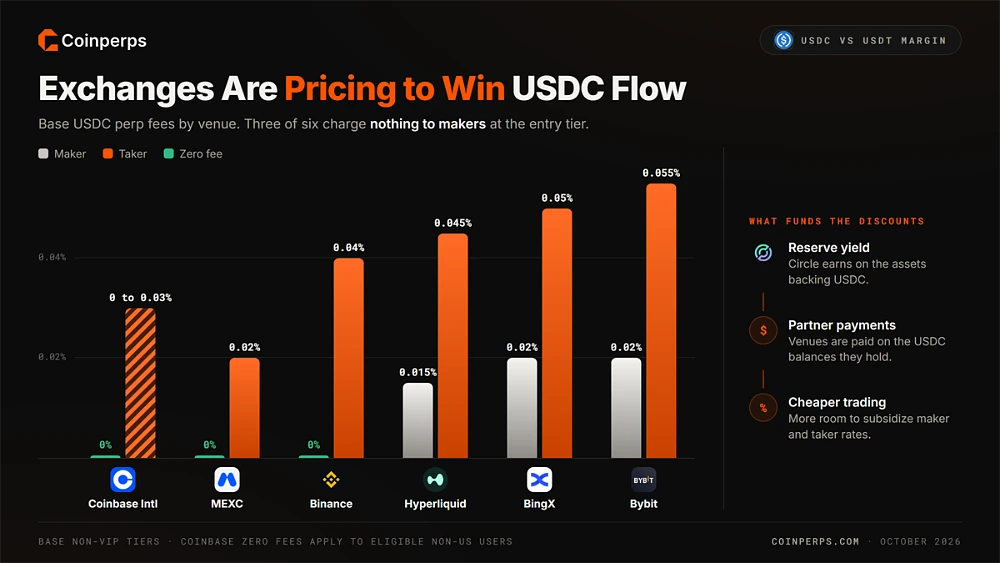
Exchanges are competing for USDC trading flow with pricing rarely matched on USDT markets. Binance's dedicated USDC-M schedule charges 0% maker and 0.04% taker. Coinbase offers zero-fee perpetuals to eligible non-US users, while MEXC regularly rotates USDC-M listings into fully fee-free campaigns.
Reserve yield helps fund some of those incentives. Circle pays partners based on USDC balances, as the Binance agreement demonstrates, giving venues more room to subsidize trading discounts. For high-volume accounts, even small maker and taker savings accumulate quickly, as shown in our lowest fee perpetual exchanges analysis.
Latest Trends in USDC Perpetual Trading for 2026
USDC perpetual trading changed quickly through 2026 as exchanges, stablecoin issuers and regulators reshaped market incentives. For traders, the main effects are visible in where liquidity is concentrating, how collateral yield is distributed and which venues remain available across different regions.
1. Exchange and Issuer Alliances
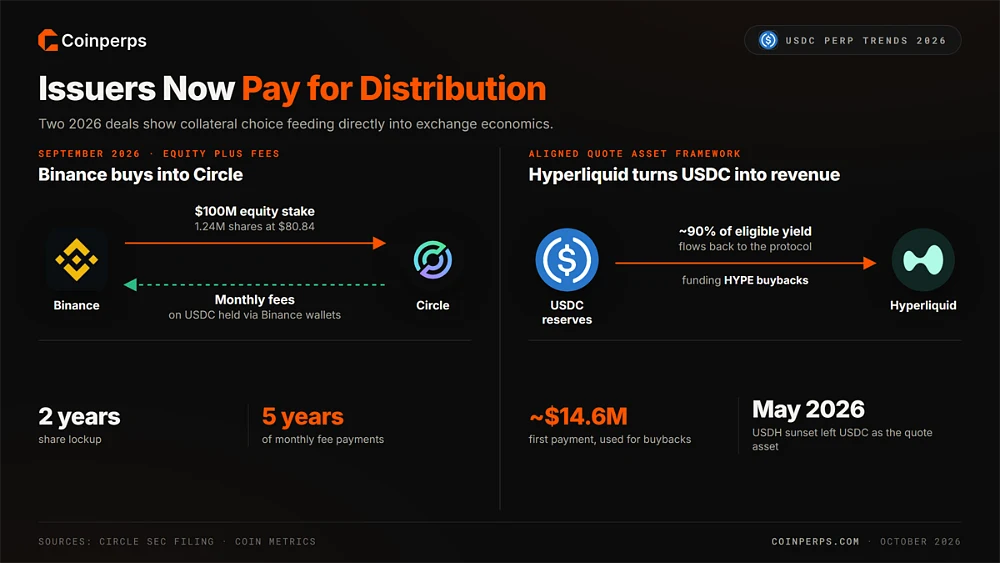
Stablecoin issuers are increasingly paying exchanges for distribution. Under Binance's September 2026 agreement, the exchange bought 1.24 million Circle shares at $80.84 each with a two-year lockup. Circle will also pay monthly fees for five years based on USDC held through Binance's wallet infrastructure, according to Circle's SEC filing.
Hyperliquid took a different approach by making USDC itself a revenue source. Through the Aligned Quote Asset framework, roughly 90% of eligible reserve yield flows back to the protocol. The first payment of about $14.6 million funded HYPE buybacks, showing that collateral selection now influences exchange economics directly.
2. Key Market Shifts
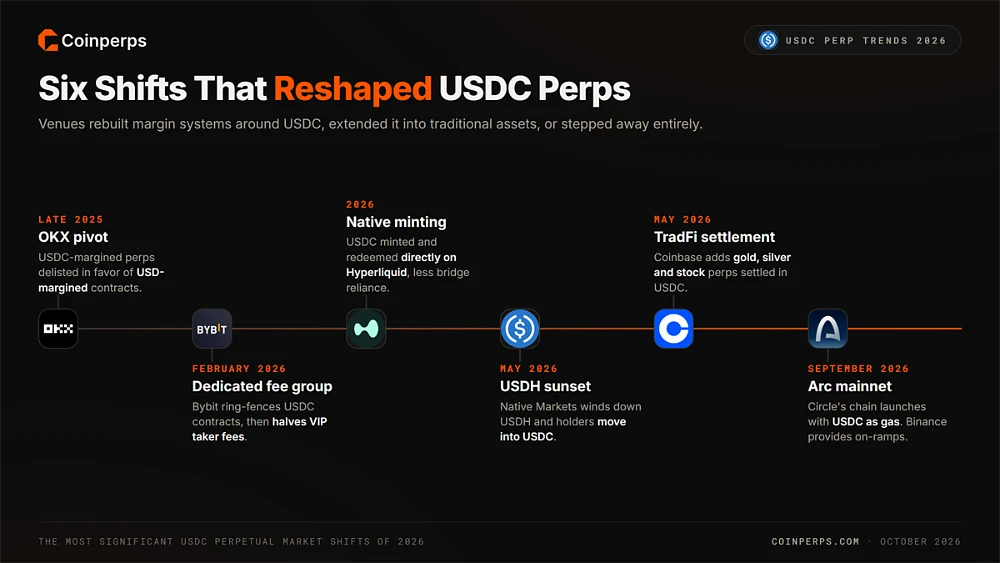
Product design is changing alongside those partnerships. Some venues are rebuilding margin systems around USDC or extending its settlement role into traditional assets. Others have moved away from dedicated USDC books and toward broader dollar-margined contracts.
The most significant USDC perpetual market shifts during 2026 include:
- Dedicated Fee Groups: Bybit moved every USDC perpetual and future into a standalone fee group in February, then cut eligible VIP taker fees on USDC pairs by up to half.
- Native Minting: USDC can now be minted and redeemed directly on Hyperliquid, reducing dependence on the Arbitrum bridge and lowering deposit friction for on-chain traders.
- TradFi Settlement: Coinbase introduced gold, silver and stock perpetuals settled in USDC, allowing commodity and equity exposure around the clock from a single stablecoin collateral balance.
- OKX Pivot: OKX delisted its USDC-margined perpetuals in late 2025, steering institutions toward USD-margined contracts that accept fiat USD, USDC or USDG within one order book.
- USDH Sunset: Native Markets wound down Hyperliquid's USDH stablecoin in May 2026, requiring holders to move into USDC and consolidating on-chain perpetual collateral around Circle's token.
- Arc Mainnet: Circle's Arc blockchain launched in September with USDC as its gas token, while Binance became one of the exchanges providing on-ramp access.
How to Choose a USDC-Margined Perpetual Exchange
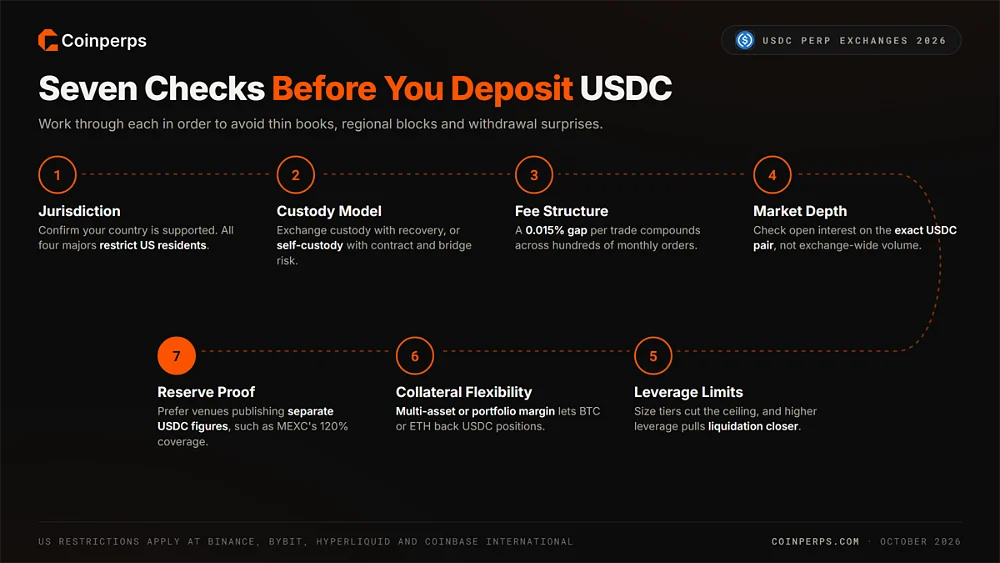
The best venue depends on trading frequency, leverage requirements, custody preferences and location. Reviewing each factor before depositing USDC can help avoid thin order books, unexpected regional blocks or withdrawal problems later.
Evaluate these factors before choosing where to trade USDC perpetuals:
- Jurisdiction: Verify that your country is supported before depositing, because Binance, Bybit, Hyperliquid and Coinbase International all restrict US residents as well as several other regions.
- Custody Model: Choose between exchange custody with account recovery and self-custody on a perp DEX, where you keep control of the keys but take on smart contract and bridge risk.
- Fee Structure: Compare base maker and taker rates together with VIP thresholds. A difference of 0.015% per trade can become substantial for scalpers placing hundreds of monthly orders.
- Market Depth: Review open interest and order book depth for the exact USDC pairs you intend to trade rather than relying on exchange-wide volume that also includes USDT markets.
- Leverage Limits: Match leverage to your strategy and remember that position-size tiers reduce the maximum available leverage. Higher leverage also moves the liquidation price closer to entry.
- Collateral Flexibility: Multi-asset or portfolio margin can be useful if you already hold BTC or ETH, because those assets may support USDC positions without extra conversions or transfer fees.
- Reserve Proof: Prefer exchanges that publish regular proof of reserves with separate USDC figures, such as MEXC's report showing 120% USDC coverage.
Pros and Cons of Trading with USDC Margin
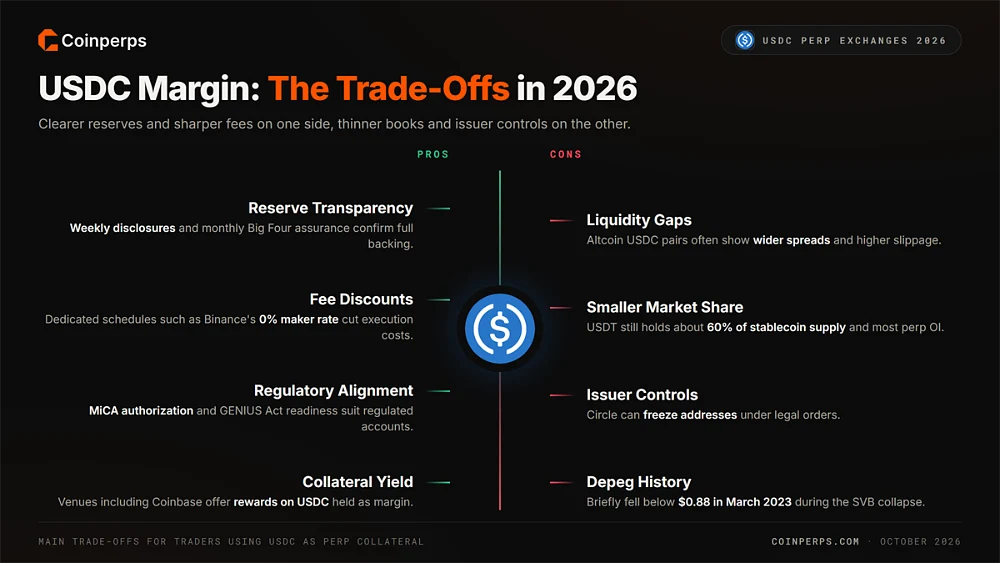
USDC margin provides clearer reserve reporting, regulatory alignment and targeted fee incentives, though those advantages come with less liquidity in some markets and fewer permissionless features. The lists below summarize the main trade-offs for traders in 2026.
Pros of USDC Margin
- Reserve Transparency: Weekly reserve disclosures and monthly Big Four assurance confirm USDC is fully backed by cash and short-dated Treasuries.
- Fee Discounts: Dedicated USDC schedules, such as Binance's 0% maker rate, cut execution costs for active traders.
- Regulatory Alignment: MiCA authorization and GENIUS Act readiness make USDC a safer collateral choice for regulated accounts.
- Collateral Yield: Some venues, including Coinbase, offer rewards on USDC held as derivatives margin.
Cons of USDC Margin
- Liquidity Gaps: Altcoin USDC pairs often show wider spreads and higher slippage than equivalent USDT-margined markets.
- Smaller Market Share: USDT still accounts for about 60% of stablecoin supply and most perpetual open interest.
- Issuer Controls: Circle can freeze addresses under legal orders, which may concern permissionless or privacy-focused traders.
- Depeg History: USDC briefly fell below $0.88 in March 2023 during the Silicon Valley Bank collapse.
Which Traders Each Venue Suits
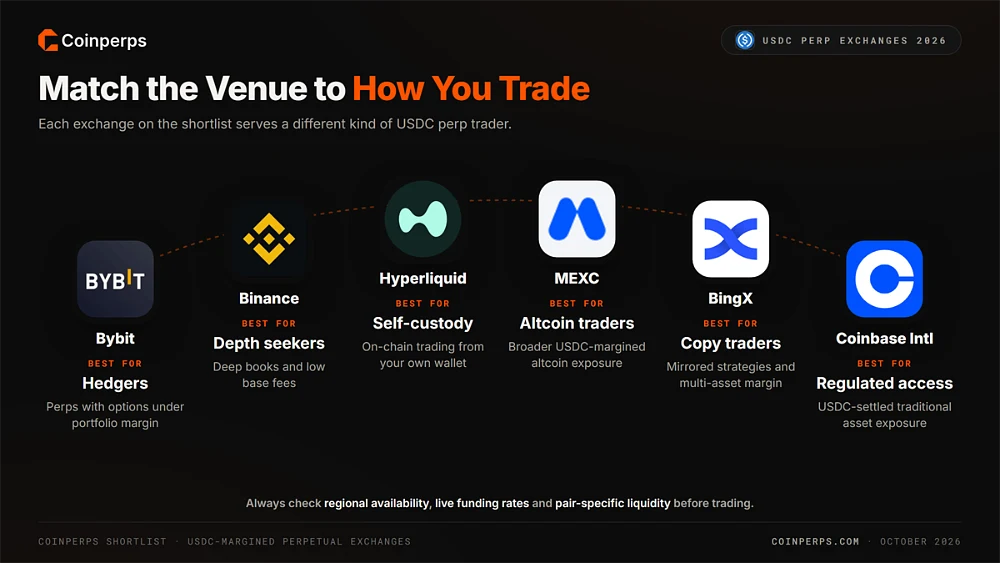
Bybit is best suited to traders combining USDC perpetuals with options or portfolio margin, while Binance stands out for deep order books and low base fees. Hyperliquid is the stronger fit for self-custodial trading, whereas MEXC serves traders looking for broader USDC-margined altcoin exposure.
BingX is more relevant to users who value copy trading and multi-asset margin. Coinbase International, by contrast, is aimed at eligible traders prioritizing regulated access and USDC-settled traditional-asset exposure. In every case, regional availability, live funding rates and pair-specific liquidity still need to be checked before trading.
Bottom Line
Bybit remains our top USDC-margined perpetual exchange because of its dedicated USDC fee group, portfolio margin and strong liquidity on major pairs. Binance follows with highly competitive base fees and the deepest order books. Traders who prefer self-custody should consider Hyperliquid, now the leading USDC-native venue for on-chain derivatives.
MEXC is better suited to altcoin speculators, while BingX stands out for copy traders. Coinbase International is the stronger choice for users prioritizing regulation and USDC-settled TradFi exposure. Whatever platform you choose, confirm regional access, compare live funding rates and keep position sizes conservative because leverage amplifies losses as quickly as gains.
With GENIUS Act rules approaching and exchanges competing for USDC balances through lower fees and yield sharing, USDC-margined perpetuals could continue gaining share in 2027. Revisit this guide regularly because promotions, leverage limits and listings change frequently across the exchanges reviewed here.
FAQs
