Cryptocurrency Perpetual Futures Statistics for 2026
Discover the latest crypto perpetual futures statistics for 2026, covering trading volume, liquidations, DEX market share, and new US-regulated perps.

- Leverage Rules Everything: Perpetual futures handled roughly $61.7 trillion in 2025 and still clear well over $100 billion on active days, leaving derivatives firmly in control of crypto price discovery.
- America Joins the Market: CFTC approvals in May 2026 allowed Kalshi and Coinbase to list onshore perps, ending years in which US traders were locked out of the asset class.
- Onchain Perps Hold Ground: Decentralized exchanges processed around $625 billion in 30-day volume into October 2026. Hyperliquid alone accounted for roughly $240 billion across its ecosystem.
Late 2026 bears little resemblance to the market euphoria of a year earlier. Bitcoin trades near $84,500 after a deep correction, but leveraged turnover across perpetual futures exchanges remains enormous. US regulators have also finally allowed the product to move onshore.
This guide brings together the freshest figures from CoinGlass, The Block, DefiLlama, and the Coinperps dashboard. It covers total derivatives turnover and liquidation records, the DEX-versus-CEX battle, real-world asset contracts, and the first CFTC-approved perpetuals in American history.
Explore the essential data driving the market today. ⬇️
Top 10 Crypto Perpetual Futures Statistics (2026)
Our research team audited every figure below during the first week of October 2026. Live readings came from the Coinperps dashboard, CoinGlass, The Block, and DefiLlama, keeping each statistic tied to the current market rather than stale cycle data.
When dashboards disagreed, we checked the figures against published CoinGecko research and primary exchange disclosures. The result is a verified snapshot of how leverage, liquidity, and market share are distributed across the derivatives landscape right now.
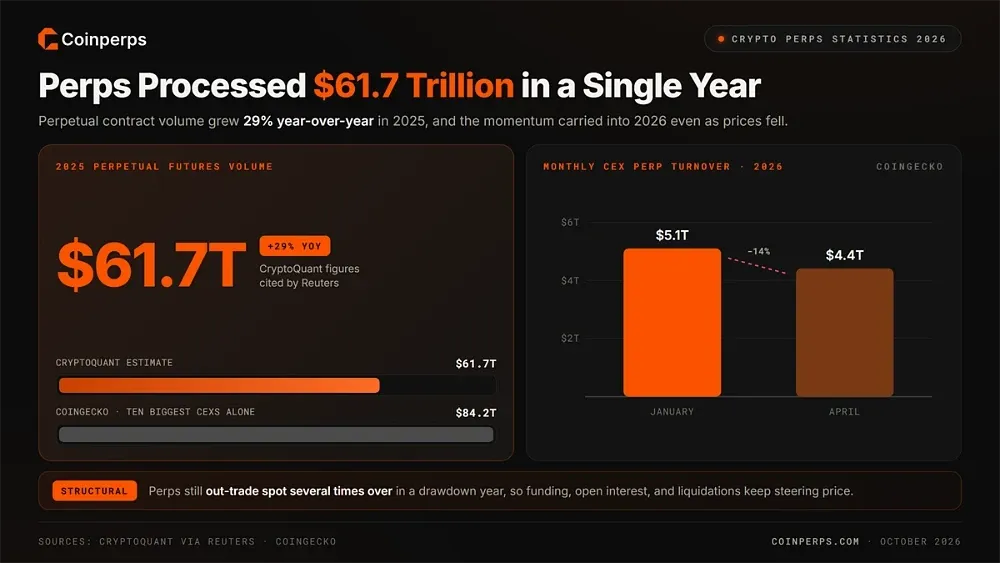
1. Perpetual Futures Processed $61.7 Trillion in a Single Year
Perpetual contracts generated roughly $61.7 trillion in trading volume during 2025, up 29% year-over-year according to CryptoQuant figures cited by Reuters. CoinGecko's broader exchange sample produces an even larger figure: $84.2 trillion across the ten biggest centralized venues alone.
That momentum carried into 2026 despite falling prices. CoinGecko's 2026 State of Crypto Perpetuals Report records $5.1 trillion in monthly centralized perp turnover in January. By April, the figure had eased to $4.4 trillion as the correction deepened and speculative appetite cooled across major venues.
The significance is structural rather than cyclical. Perpetual contracts still out-trade spot markets several times over in a drawdown year, so funding payments, open interest shifts, and liquidation clusters continue to influence short-term price direction across the asset class.
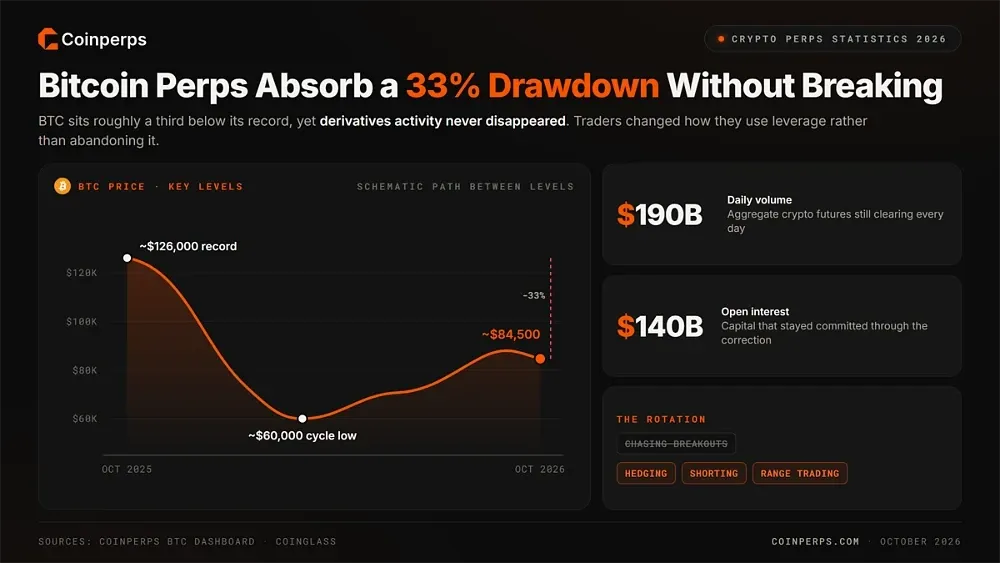
2. Bitcoin Perps Absorb a 33% Drawdown Without Breaking
Latest readings from the Coinperps Bitcoin perpetual futures dashboard put BTC near $84,500 in early October 2026, roughly a third below the record just above $126,000 set twelve months earlier. Bitcoin touched a cycle low around $60,000 before recovering through the third quarter.
Derivatives activity never disappeared. Aggregate crypto futures still clear close to $190 billion in daily volume against around $140 billion in open interest, according to CoinGlass data. Rather than abandoning leverage, traders rotated from chasing breakouts toward hedging, shorting, and range trading.
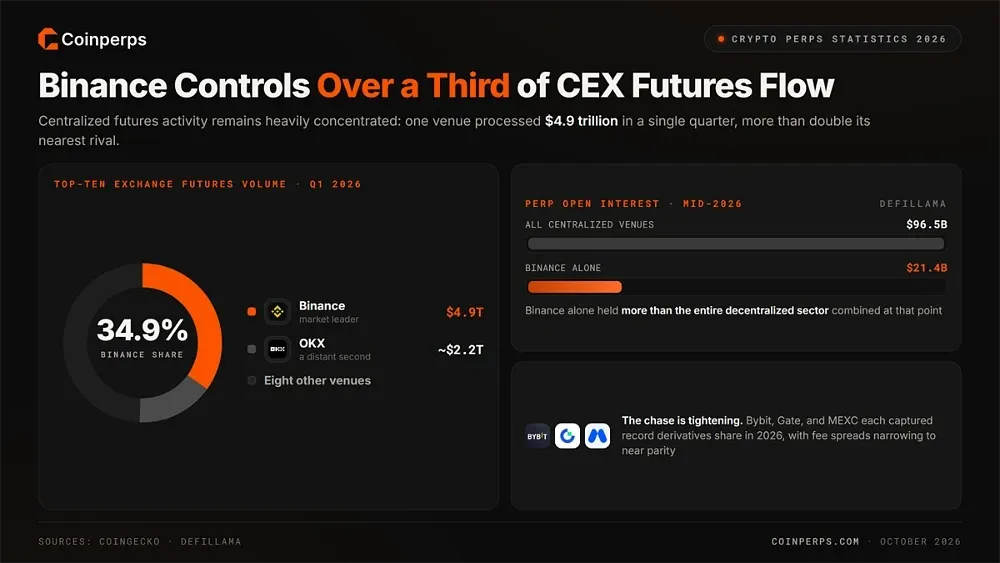
3. Binance Controls Over a Third of Centralized Futures Flow
Centralized futures activity remains heavily concentrated. CoinGecko data shows Binance processed about $4.9 trillion in futures volume during Q1 2026, equal to 34.9% of the top-ten exchange total. OKX ranked a distant second at close to $2.2 trillion for the quarter.
Open interest shows a similar imbalance. A DefiLlama breakdown from mid-2026 places roughly $96.5 billion of perp open interest on centralized venues. Binance alone held $21.4 billion, more than the entire decentralized sector combined at that point.
Competition behind the market leader is tightening. Bybit, Gate, and MEXC have each captured record derivatives share during 2026's choppy months. Our exchange comparison tool also shows fee spreads between them narrowing to near parity.
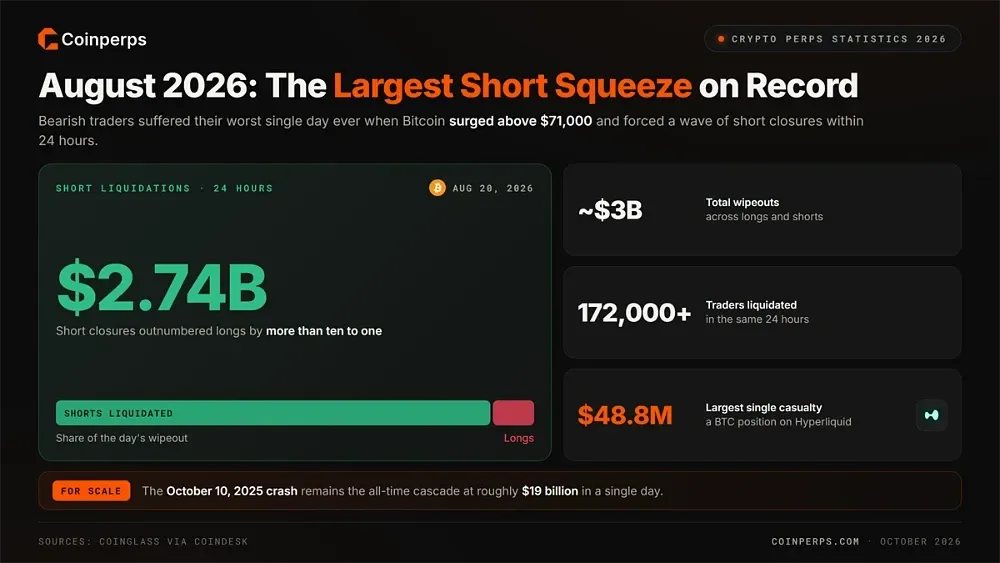
4. August 2026 Delivered the Largest Short Squeeze on Record
Bearish traders suffered their worst single day ever on August 20, 2026. Bitcoin surged above $71,000 and forced nearly $2.74 billion in short liquidations within 24 hours, according to CoinGlass data reported by CoinDesk.
Total wipeouts approached $3 billion across more than 172,000 traders, with short closures outnumbering longs by more than ten to one. The largest individual casualty was a $48.8 million Bitcoin position on Hyperliquid, liquidated during the hour when the squeeze accelerated.
For comparison, the October 10, 2025 crash remains the all-time cascade at roughly $19 billion in a single day. Traders now use our Bitcoin liquidation heatmap specifically to identify where these stop-hunt magnets may be forming next.
5. Long Liquidations and Negative Funding Define the Correction
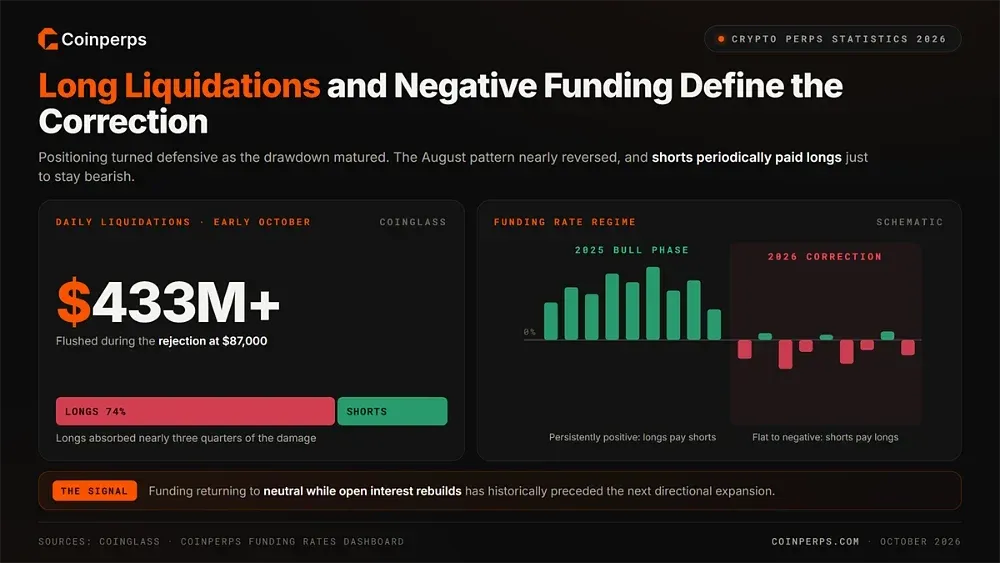
Positioning turned defensive as the drawdown matured. During early October's rejection at $87,000, CoinGlass recorded more than $433 million in daily liquidations. Longs absorbed 74% of the damage, nearly reversing the short-dominated squeezes seen in August.
The Coinperps funding rates dashboard reflects the same caution. Extended periods of flat-to-negative funding across major assets replaced the persistently positive rates of the 2025 bull phase, meaning shorts periodically paid longs simply to maintain bearish exposure.
That environment gives the long/short ratio more importance than price alone. When funding returns to neutral as open interest rebuilds, the pattern has historically preceded the market's next directional expansion in either direction.
6. The DEX-to-CEX Futures Ratio Cooled From Its Record
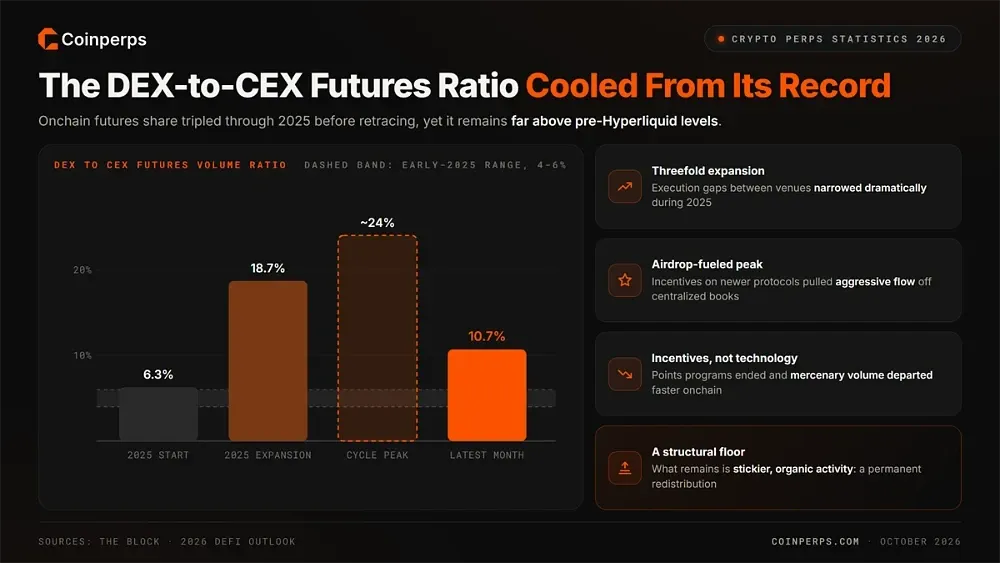
The DEX to CEX Futures Trade Volume chart from The Block captures one of 2026's more surprising reversals. Onchain futures share tripled through 2025 before retracing significantly, although it remains far above pre-Hyperliquid levels.
The ratio's journey over the past 24 months looks like this:
- 2025 Expansion: The Block's 2026 DeFi Outlook documented the ratio rising from 6.3% to 18.7% during the year, a threefold increase as execution gaps between venues narrowed dramatically.
- Late-2025 Peak: Readings reached roughly 24% at the cycle high, when airdrop incentives on newer protocols drew aggressive trading flow away from centralized books.
- 2026 Retracement: The latest monthly reading has since cooled toward 10.7%, with incentive-driven volume disappearing faster onchain than on centralized venues.
- Structural Floor: Despite the pullback, decentralized share remains well above the 4-6% range of early 2025, confirming a permanent redistribution rather than a temporary fad.
The retracement says more about incentives than technology. Points programs ended and mercenary volume departed. What remains on decentralized perpetual exchanges is stickier, organic trading activity.
7. Perp DEX 30-Day Volume Stabilizes Near $625 Billion
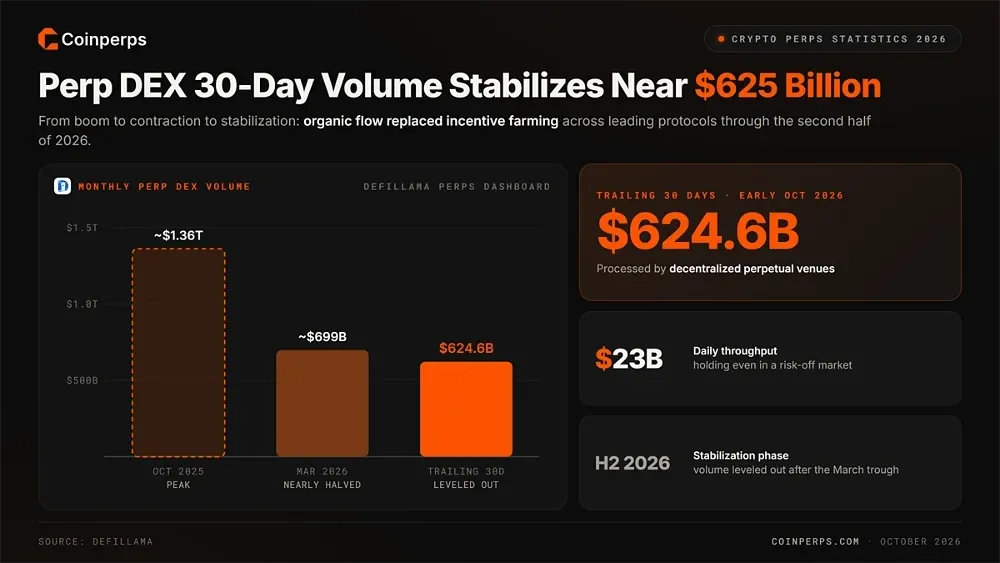
According to DefiLlama's perps dashboard, decentralized perpetual venues processed approximately $624.6 billion over the trailing 30 days into early October 2026. Daily throughput remained around $23 billion even in a risk-off market.
The longer trajectory moved from boom to contraction and then stabilization. Monthly volume peaked near $1.36 trillion in October 2025, nearly halved to roughly $699 billion by March 2026, then leveled out through the second half as organic flow replaced incentive farming across leading protocols.
8. Hyperliquid Still Clears Nearly 4x Its Closest Onchain Rival
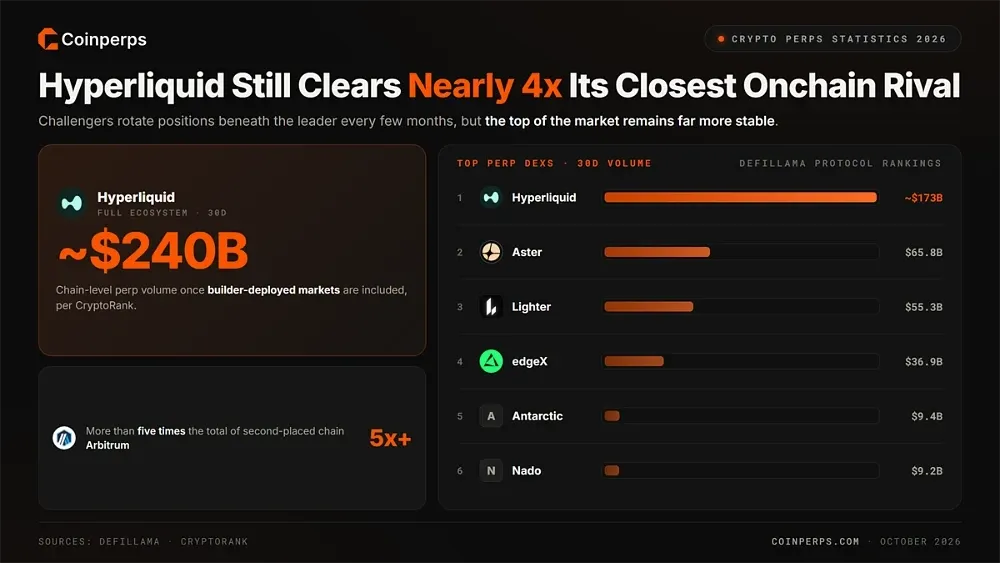
DefiLlama's protocol rankings show onchain liquidity continuing to consolidate around a small group of winners. Challengers have rotated positions beneath the leader every few months throughout 2026, but the top of the market remains far more stable.
The top decentralized venues by 30-day trading volume currently are:
- Hyperliquid: ~$173 Billion
- Aster: $65.8 Billion
- Lighter: $55.3 Billion
- edgeX: $36.9 Billion
- Antarctic: $9.4 Billion
- Nado: $9.2 Billion
Measured at the chain level, CryptoRank data puts the full Hyperliquid ecosystem near $240 billion in 30-day perpetual volume once builder-deployed markets are included. That is more than five times second-placed Arbitrum's total.
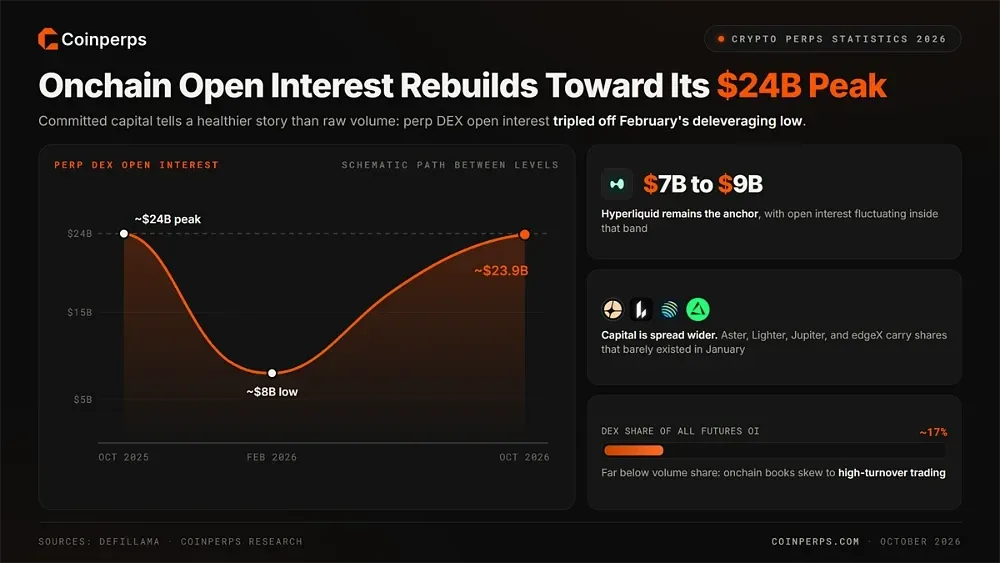
9. Onchain Open Interest Rebuilds Toward Its $24 Billion Peak
Committed capital tells a healthier story than raw volume. Perp DEX open interest peaked near $24 billion in early October 2025, collapsed to roughly $8 billion during February's deleveraging low, and has since rebuilt to approximately $23.9 billion.
Capital is also distributed more broadly than before. Hyperliquid remains the anchor, with open interest fluctuating between $7 billion and $9 billion. Aster, Lighter, Jupiter, and edgeX now carry meaningful shares that barely existed when the previous Coinperps audit ran in January.
Even so, decentralized venues still hold only about 17% of aggregate crypto futures open interest, far below their volume share. The gap suggests onchain books skew toward high-turnover trading, while longer-duration institutional positioning continues to favor centralized margin infrastructure.
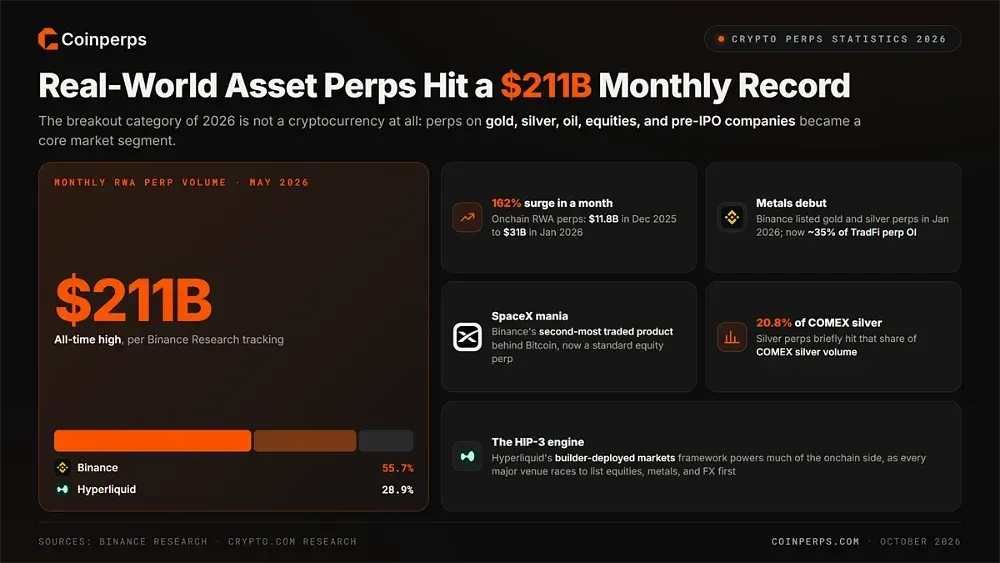
10. Real-World Asset Perps Hit a $211 Billion Monthly Record
The breakout product category of 2026 is not a cryptocurrency at all. Perpetuals tracking gold, silver, oil, equities, and pre-IPO companies expanded into a core market segment this year.
Key milestones in the RWA perpetuals boom include:
- Record Month: Monthly real-world asset perp volume reached an all-time high of $211 billion in May 2026, with Binance holding 55.7% share and Hyperliquid 28.9% per Binance Research tracking.
- 162% Surge: Crypto.com Research measured onchain RWA perp volume jumping from $11.8 billion in December 2025 to $31 billion in January 2026 alone.
- Metals Debut: Binance listed its first gold and silver perpetuals in January 2026, and the exchange now holds roughly 35% of all TradFi perp open interest.
- SpaceX Mania: Binance reported its SpaceX perpetual became the venue's second-most traded product behind Bitcoin, transitioning from a pre-IPO contract to a standard equity perp after the Nasdaq listing.
- COMEX Rivalry: Silver perpetuals briefly reached 20.8% of COMEX silver volume, showing crypto-native rails siphoning genuine flow from traditional commodity markets.
- HIP-3 Engine: Hyperliquid's builder-deployed markets framework powers much of the onchain side, a trend we unpack fully in our decentralized perpetual futures statistics report.
RWA contracts give the perpetual format its clearest path beyond crypto's market cap ceiling. Every major venue is now racing to list equities, metals, and FX pairs first.
What are Cryptocurrency Perpetual Futures
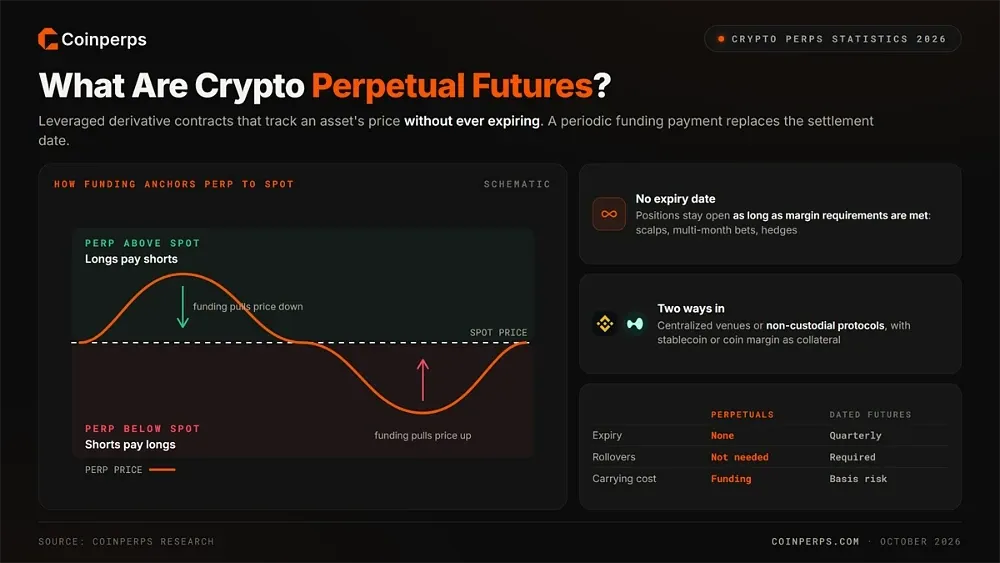
Cryptocurrency perpetual futures are leveraged derivative contracts that track an underlying asset's price without expiring. A periodic funding payment between long and short holders keeps the contract anchored to spot value, replacing the settlement dates that tether traditional futures to their index.
Traders can access them through centralized venues such as Binance or non-custodial protocols such as Hyperliquid, posting stablecoin or coin margin as collateral. Because positions stay open for as long as margin requirements are met, perps can support scalping, months-long directional bets, and portfolio hedging.
The difference from dated futures matters for strategy. Quarterly contracts require rollovers and carry basis risk. Perpetuals remove that friction but introduce ongoing funding costs instead. Our full breakdown of perpetuals versus standard futures explains when each structure actually wins.
Crypto Perpetual Futures Pros and Cons
Perpetual contracts offer considerable flexibility for leveraged trading, but the same mechanics that create opportunity can drain an account quickly when risk is not controlled.
Regulated Perpetual Futures Arrive in the US
The biggest structural shift of 2026 happened in Washington rather than on a trading venue. After years of offshore exile, perpetual contracts can now trade legally on CFTC-registered American exchanges for the first time.
The CFTC Approval Timeline
Momentum built quickly after the leadership change. The CFTC cleared Bitnomial for near-perpetual products in December 2025, then issued its landmark order on May 29, 2026. The decision permitted Kalshi to list a true Bitcoin perpetual while granting Coinbase no-action relief for digital commodity derivatives.
Adoption exceeded expectations almost immediately. Fortune reported that Kalshi became the first US firm blessed to offer the product, and its perps crossed $1 billion in volume within a week of going live. An Ethereum contract followed on June 4, with metals, FX, and energy expansions already under regulatory discussion.
For Coinbase Futures, the relief opened access to what CEO Brian Armstrong described as the roughly 80% of global crypto market activity American users had been locked out of, bringing perps and options into the domestic product stack.
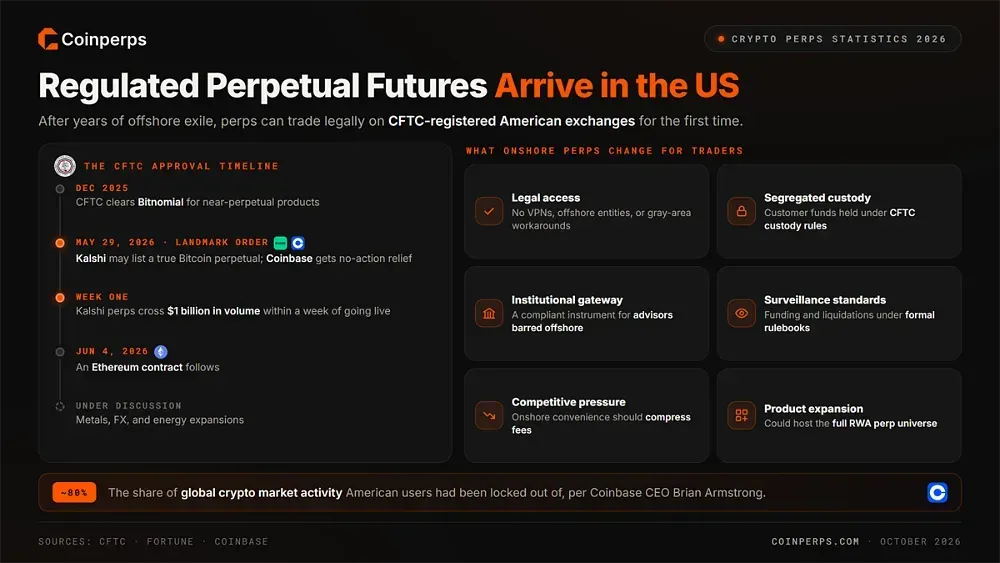
What Onshore Perps Change for Traders
Bringing the asset class under CFTC oversight changes practical realities for American participants, from custody protections to market structure, in ways offshore venues could not offer.
The most important changes introduced by regulated US perpetuals:
- Legal Access: US residents can finally trade perps without VPNs, offshore entities, or gray-area workarounds, removing the compliance risk that shadowed an entire generation of traders.
- Segregated Custody: Regulated clearing requires customer funds be held under CFTC custody rules, directly addressing the exchange collapses that defined earlier crypto cycles.
- Institutional Gateway: Pension-adjacent capital and registered advisors barred from offshore venues now have a compliant instrument, widening the realistic buyer base for leveraged crypto exposure.
- Surveillance Standards: Designated contract markets must monitor manipulation and disclose mechanics, placing funding calculations and liquidation engines under formal rulebooks rather than exchange discretion.
- Competitive Pressure: Offshore giants now compete against onshore convenience, which should compress fees and force transparency improvements across every major perpetual futures exchange.
- Product Expansion: Regulators are already weighing perpetuals on metals, foreign exchange, and energy, suggesting the US framework could eventually host the full RWA perp universe.
The offshore market still dwarfs onshore volume today. Even so, the direction of travel is unmistakable: perps are becoming a mainstream, regulated American asset class.
Cryptocurrency Perpetual Futures Predictions for 2027
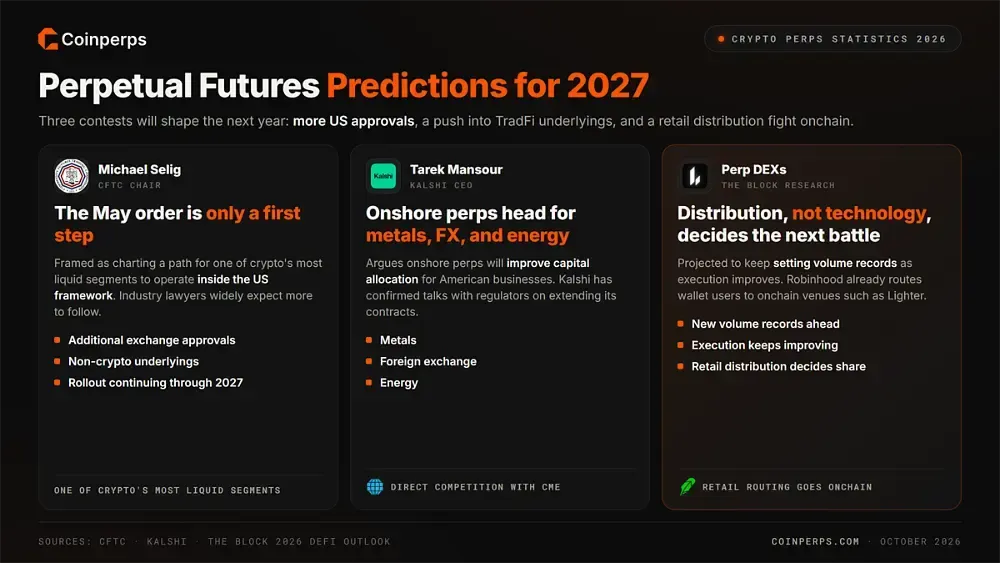
CFTC Chair Michael Selig has framed the agency's May order as only a first step, describing it as charting a path for one of crypto's most liquid segments to operate inside the US framework. Industry lawyers widely expect additional exchange approvals and non-crypto underlyings through 2027.
Kalshi CEO Tarek Mansour argues that onshore perps will improve capital allocation for American businesses. The firm has also confirmed discussions with regulators about extending its contracts into metals, foreign exchange, and energy, which would put those products into direct competition with CME's legacy franchises.
The decentralized market faces a different contest. The Block's research team projected in its 2026 DeFi Outlook that perp DEXs would continue setting volume records as execution improves. With Robinhood already routing wallet users to onchain venues such as Lighter, analysts see retail distribution, rather than protocol technology, deciding the next market share battle.
Risks of Using Crypto Perpetual Futures
Trading perpetual contracts in 2026's volatile, macro-driven environment requires genuine respect for leverage. Forced closures and recurring funding costs can erase accounts faster than many newcomers expect.
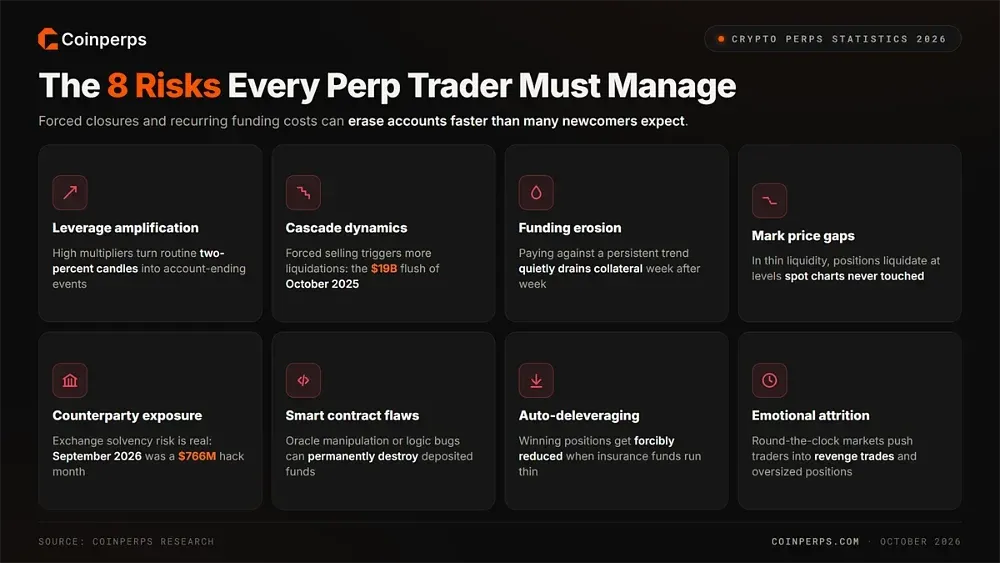
The primary dangers every perpetual trader must manage include:
- Leverage Amplification: High multipliers reduce the price move needed to wipe out margin entirely, turning routine two-percent candles into account-ending events for aggressive positions.
- Cascade Dynamics: Clustered liquidation levels create chain reactions in which forced selling triggers further liquidations, exactly the mechanism behind October 2025's $19 billion single-day flush.
- Funding Erosion: Paying funding against a persistent trend quietly drains collateral week after week, often costing more than the original thesis was ever worth.
- Mark Price Gaps: During thin liquidity, divergence between index and mark prices can liquidate positions at levels spot charts never actually touched.
- Counterparty Exposure: Collateral parked on centralized venues carries exchange solvency risk, and September 2026's $766 million hack month showed that security failures remain very real.
- Smart Contract Flaws: Onchain protocols replace custody risk with code risk, where oracle manipulation or logic bugs can permanently destroy deposited funds.
- Auto-Deleveraging: Winning positions can be forcibly reduced when insurance funds run thin, a mechanic explained in our guide to avoiding auto-deleveraging.
- Emotional Attrition: Round-the-clock markets combined with visible unrealized losses can push traders into revenge trades and oversized positions that disciplined plans would never allow.
Bottom Line
The 2026 perpetuals market proved its resilience the hard way. It maintained enormous turnover and rebuilt open interest through a 33% Bitcoin drawdown that would have hollowed out earlier cycles.
The frontier has shifted. US regulatory approval, real-world asset contracts, and the consolidation of onchain liquidity now matter more than raw volume records when assessing where derivatives go next.
Traders who combine live data on funding, liquidations, and positioning with strict risk management are the ones positioned to survive this market's volatility and capture its next expansion.
FAQs
