Inverse Perpetual Contracts Explained | Best Exchanges
Compare the seven best inverse perpetual contract exchanges of 2026 on collateral support, fees, and leverage & learn how coin-margined trading works.

Disclosure: Coinperps may earn a commission from partner links, at no extra cost to you. Reviews are based on independent testing — see how we test.
- Inverse perpetual contracts are quoted in dollars but margined and settled in crypto, so your collateral and your profits both move with the coin you hold.
- The leading platforms in 2026, including Bybit, Binance, OKX, and Kraken, differ sharply on collateral currencies, funding intervals, and leverage caps, making the right fit a genuine edge.
- From collateral volatility to funding drag, understanding how the inverse payout curve behaves matters far more than the headline leverage number any exchange advertises.

Bybit
Bybit, founded in 2018 and headquartered in Dubai, is the world’s second-largest exchange by volume, serving 60 million users with 1,800+ assets and over $11 billion in daily trading.
Features
Fees
Regulation
Overall Rating
The exchange that invented the inverse perpetual will not survive the year. BitMEX confirmed in July 2026 that it closes for good on 23 September, ending an eleven-year run that began with a Bitcoin-margined contract nobody else was offering.
That closure is a fitting moment to ask which platforms still take coin-margined trading seriously. Stablecoin-settled contracts won the volume war years ago, and several exchanges quietly let their inverse books wither. A smaller group kept building, and those are the ones worth your collateral.
We funded accounts, opened positions in BTC and ETH terms, and watched how each platform handled margin, funding, and liquidation when the collateral itself was moving. This guide ranks the seven that hold up, then explains the mechanics that make inverse contracts behave unlike anything else you trade.
What Are Inverse Perpetual Contracts?
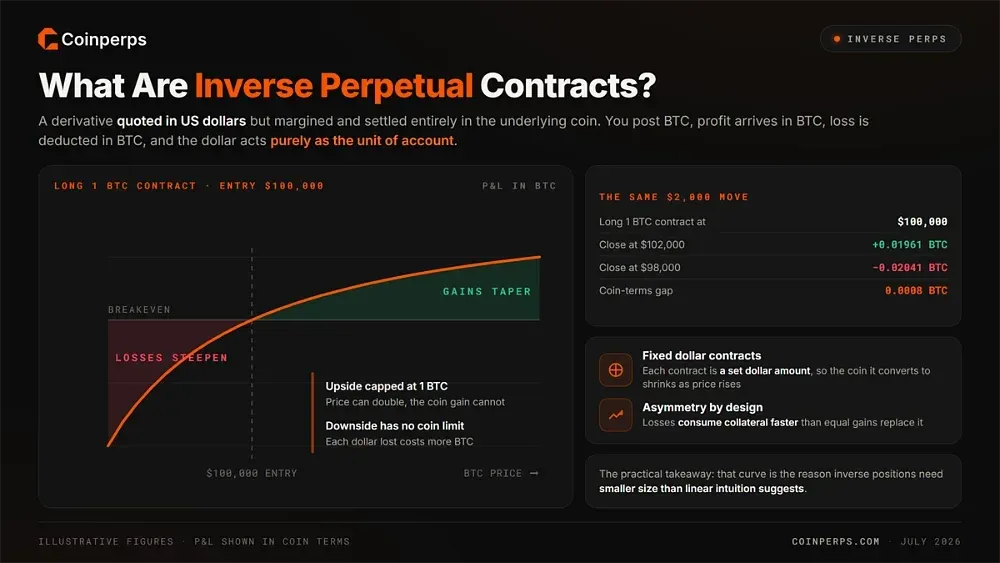
An inverse perpetual contract is a derivative quoted in US dollars but margined and settled entirely in the underlying crypto asset. You post BTC as collateral, your profit arrives in BTC, and your loss is deducted in BTC, with the dollar acting purely as the unit of account.
That structure produces the non-linear payout that gives the contract its name. Because each contract represents a fixed dollar amount, the quantity of crypto it converts to shrinks as price rises and grows as price falls, so your gains and losses in coin terms are asymmetric by design.
A worked example makes it concrete. Going long 1 BTC at $100,000 and closing at $102,000 returns roughly 0.01961 BTC, calculated as $2,000 divided by $102,000. Had price instead fallen to $98,000, the same $2,000 move would cost about 0.02041 BTC, a larger amount of crypto.
That asymmetry is the mathematical core of the instrument, and academic work on perpetual futures pricing traces how it shaped early market structure. The practical takeaway is that losses consume collateral faster than equivalent gains replace it, which changes how you size positions.
The 7 Best Inverse Perpetual Contract Exchanges
Ranking coin-margined platforms means weighing criteria that barely matter on a stablecoin book. Which coins can actually serve as collateral, how frequently funding settles, and whether the liquidation logic properly accounts for margin that falls at the same moment your position moves against you.
We weighted collateral breadth and inverse-book liquidity most heavily, then fee structure, leverage flexibility, and regulatory access. Depth matters more here than on linear pairs because inverse order books are thinner across the industry, so slippage does more damage than a basis point of fee difference ever will.
Exchange | Inverse Pairs | Max Leverage | Maker / Taker | Collateral | Stand-Out Feature |
|---|---|---|---|---|---|
BTC, ETH, SOL, XRP and more | Up to 100x | 0.02% / 0.055% | Coin held | Deepest inverse books and clean margin UI | |
BTC, ETH, BNB, XRP and more | Up to 125x | 0.015% / 0.04% | Coin held | Widest collateral menu on Coin-M futures | |
BTC, ETH and majors | Up to 100x | 0.02% / 0.05% | Coin held | Unified account across spot and derivatives | |
BTC, ETH and majors | Up to 50x | 0.02% / 0.05% | Base asset only | Regulated access with hourly funding | |
BTC, ETH | Up to 50x | 0.00% / 0.05% | Coin held | Institutional depth, now Coinbase-owned | |
BTC, ETH and majors | Up to 200x | Tier-based | Coin held | Highest leverage on coin-margined books | |
BTC, ETH | Up to 100x | 0.02% / 0.06% | Coin held | Simplest onboarding for first-time users |
1. Bybit
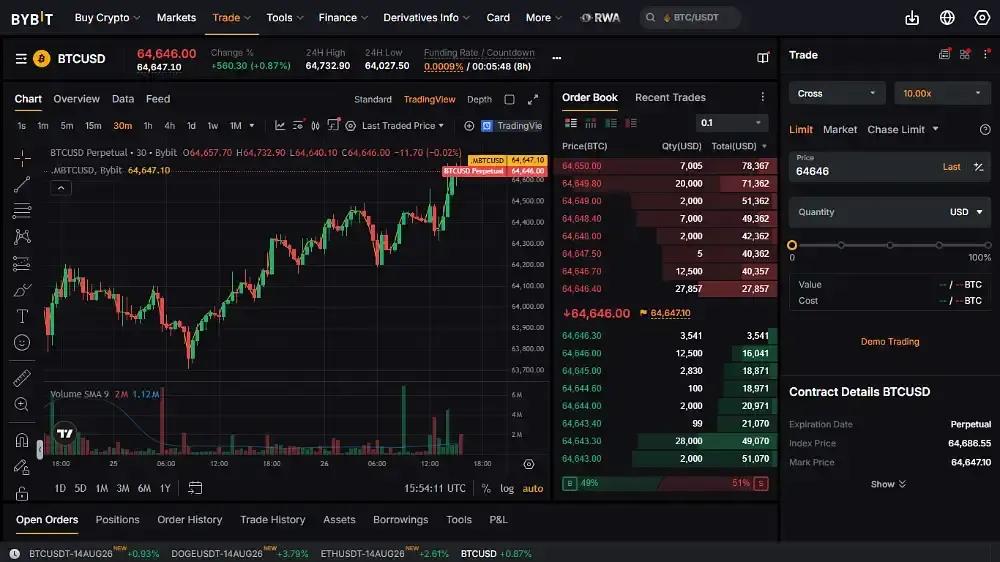
Bybit takes the top position because it treats inverse contracts as a first-class product rather than a legacy holdover. Its BTCUSD and ETHUSD books carry the depth that matters when you are trading a contract type most of the industry has neglected, and spreads stayed workable throughout our testing.
Collateral flows through the Unified Trading Account, so the coin you already hold margins the position directly with no stablecoin conversion step. Leverage reaches 100x on majors, and the liquidation price display updates against your crypto margin in real time, which is exactly the number that matters when collateral value is moving underneath you.
The interface earns particular credit for showing margin, position value, and unrealised profit in coin terms rather than forcing a mental dollar conversion. Fees sit around 0.02% maker and 0.055% taker at the base tier, competitive without being the outright cheapest option here.
Pros
- Deepest inverse order books across BTC, ETH, and major altcoin pairs.
- Unified account margins positions directly from the coin you hold.
- Margin and profit displayed in crypto terms, matching how inverse contracts settle.
Cons
- Base taker fee runs above Binance and Deribit on coin-margined books.
- Inverse pairs beyond the majors carry noticeably thinner liquidity.
- Not available to users in the United States or several restricted regions.
2. Binance
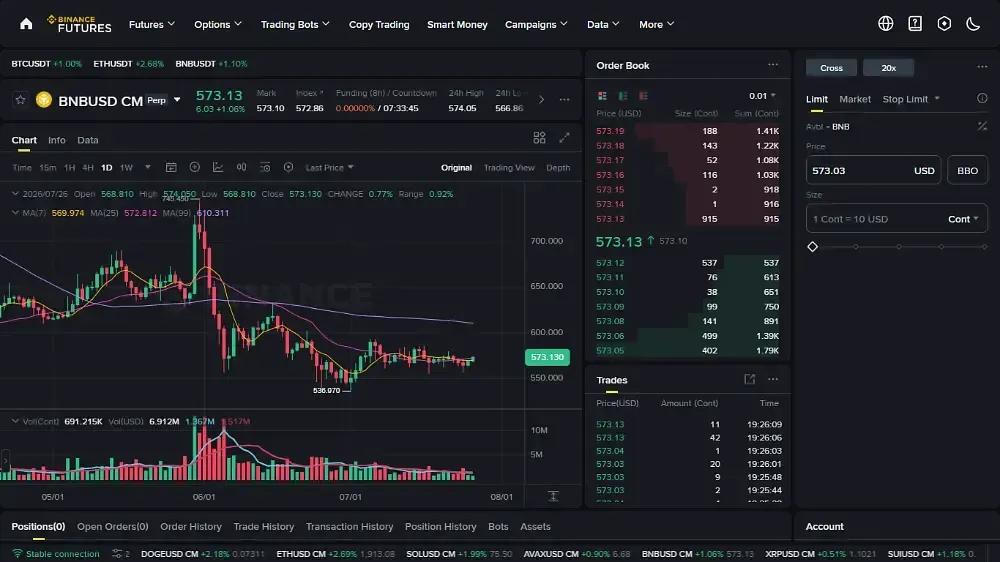
Binance runs the broadest coin-margined lineup of any exchange, with COIN-M futures accepting BTC, ETH, BNB, XRP, and a long list of additional assets as collateral. If you hold something other than Bitcoin and want inverse exposure without converting it first, no rival comes close.
The fee structure rewards that choice, since COIN-M contracts price below the stablecoin-margined equivalents at roughly 0.015% maker and 0.04% taker before any BNB discount. Leverage extends to 125x on the flagship pairs, and liquidity on BTCUSD perpetuals rivals anything available anywhere.
The trade-off is regulatory reach. Coin-margined access varies by jurisdiction as the exchange restructures its regional footprint, a moving picture our Binance futures restricted countries guide tracks. Where you can reach it, the combination of collateral breadth and depth is unmatched.
Pros
- Widest collateral menu, accepting BTC, ETH, BNB, XRP and more.
- COIN-M fees price below the stablecoin-margined equivalent contracts.
- Leverage to 125x with liquidity matching the deepest books available.
Cons
- Jurisdictional access keeps narrowing as regional operations restructure.
- The VIP and discount system adds complexity for casual traders.
- Interface density can overwhelm anyone new to coin-margined products.
3. OKX
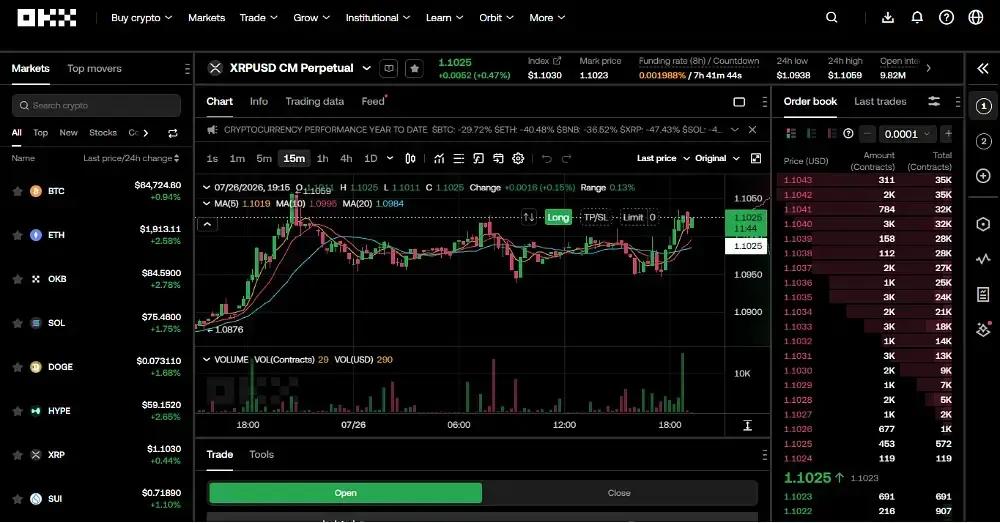
OKX built its crypto-margined swaps into a unified account that recognises collateral across spot, futures, and options in a single balance. For a trader holding BTC who wants inverse exposure while running other positions, that shared margin pool removes a real capital drag.
Its documentation deserves mention because inverse mechanics confuse people, and OKX publishes worked examples showing exactly how contract value converts to coin terms at different price levels. Pairing that with a demo mode makes it the most approachable route into coin-margined trading for anyone still building intuition.
Depth on BTC and ETH inverse pairs is solid, though it trails Bybit and Binance once you move to smaller assets. Leverage reaches 100x on majors, and the fee schedule at roughly 0.02% maker and 0.05% taker drops meaningfully for OKB holders and higher tiers.
Pros
- Unified account shares collateral across spot, futures, and options positions.
- Clear documentation and demo mode ease the coin-margined learning curve.
- Competitive tiered fees with additional reductions for OKB holders.
Cons
- Inverse depth trails Bybit and Binance outside the flagship pairs.
- Coin-margined coverage focuses on majors rather than a broad altcoin list.
- Derivatives access remains limited for users based in the United States.
4. Kraken
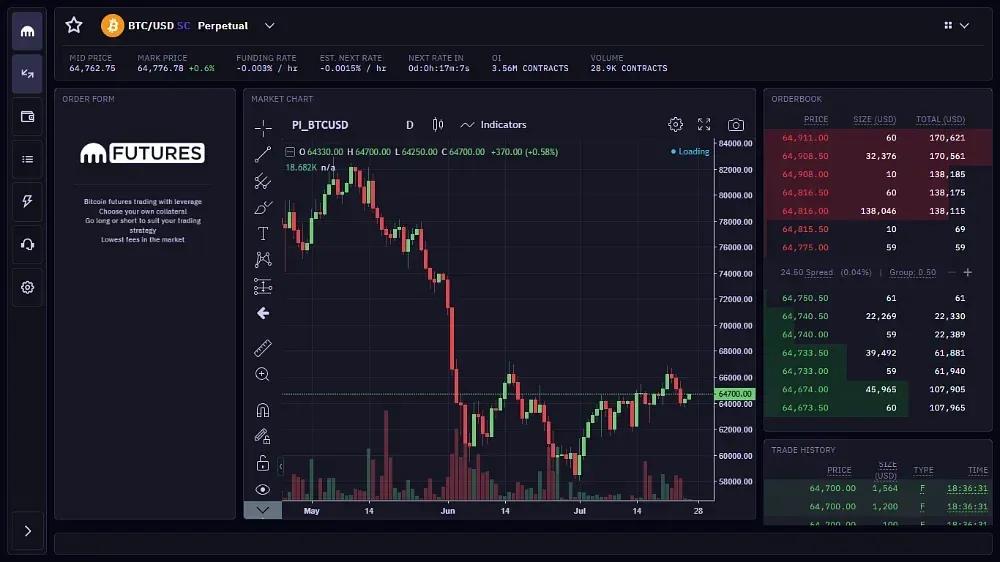
Kraken is the regulated choice on this list, running Coin-M inverse contracts through an entity supervised in the European Economic Area rather than an offshore structure. For traders who want recourse and a real compliance perimeter around coin-margined positions, nothing else here compares.
Its funding mechanism is genuinely different. Where most platforms settle funding every eight hours, Kraken accrues it continuously and realises it hourly, which its inverse contract specifications document in detail. Shorter intervals smooth the cost curve and reduce the spike risk around scheduled settlement windows.
The constraints are scope and leverage. Coin-M contracts accept only the base asset of the pair as collateral, so a BTC contract requires BTC, and leverage caps sit well below offshore platforms. Operating since 2011 without a client-fund breach, it trades maximum leverage for durability.
Pros
- Regulated operation with genuine recourse, unusual for coin-margined products.
- Hourly funding realisation smooths costs versus eight-hour settlement cycles.
- Long operating history with no client-fund breach since 2011.
Cons
- Coin-M contracts accept only the pair's base asset as collateral.
- Leverage caps sit well below the offshore platforms on this list.
- Inverse pair selection is narrower than the large global exchanges.
5. Deribit
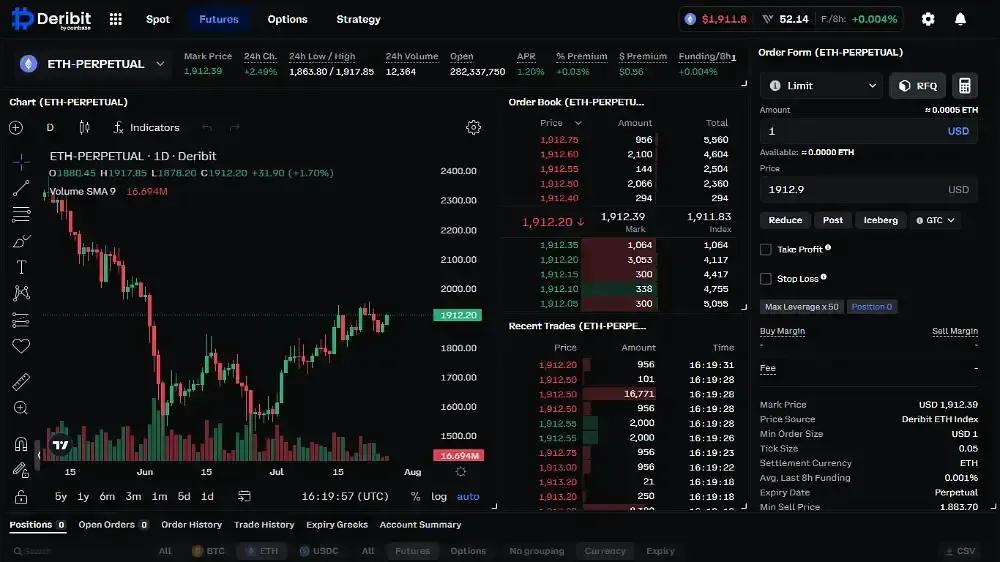
Deribit has run Bitcoin-settled perpetuals since long before coin-margined trading became a niche, and its inverse books still carry the institutional flow that makes execution predictable during volatility. It now operates inside Coinbase following an acquisition that closed in August 2025.
The platform pairs a zero percent maker fee on perpetuals with portfolio margining that recognises offsetting exposure across its options and futures books. For anyone hedging an inverse perpetual position with options on the same underlying, that cross-product margin treatment is a material capital saving.
Coverage is deliberately narrow, concentrating on BTC and ETH rather than chasing a long list. The interface assumes you already understand what you are doing, offering little guidance for newcomers, and access excludes the United States alongside several other restricted jurisdictions.
Pros
- Zero maker fee on perpetuals with deep institutional inverse liquidity.
- Portfolio margin recognises offsetting options and futures exposure together.
- Coinbase ownership adds balance-sheet strength behind the platform.
Cons
- Coverage limited to BTC and ETH with no altcoin inverse pairs.
- Interface assumes prior derivatives experience and offers minimal guidance.
- Unavailable to US residents and several restricted jurisdictions.
6. MEXC
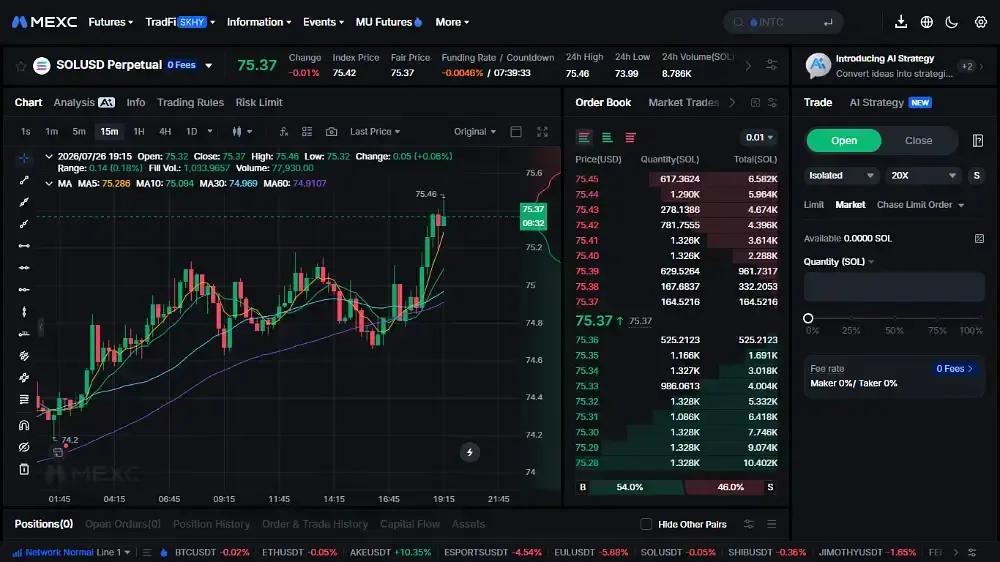
MEXC offers the most aggressive leverage on coin-margined books, reaching 200x on Coin-M perpetual futures where most competitors stop at 100x. Paired with a fee schedule that consistently undercuts the majors, it is built for traders who prioritise cost and capital efficiency above everything else.
Its Coin-M documentation walks through margin and profit calculations using worked BTC examples, which helps when you are verifying liquidation maths on a contract type where the collateral moves against you during a drawdown. Coverage extends across BTC, ETH, and a wider altcoin list than most inverse books carry.
Two caveats deserve real weight here. That 200x ceiling functions as a liquidation risk multiplier rather than a feature for almost every retail account, and MEXC operates offshore without tier-one licensing, appearing on several restricted lists our MEXC restricted countries guide covers.
Pros
- Leverage to 200x on Coin-M books, the highest available here.
- Fee schedule consistently undercuts the larger global exchanges.
- Broader altcoin coverage than most inverse contract lineups offer.
Cons
- Extreme leverage magnifies liquidation risk on already volatile collateral.
- Offshore licensing provides weaker recourse than regulated alternatives.
- Advanced order types trail Binance and OKX in sophistication.
7. KuCoin
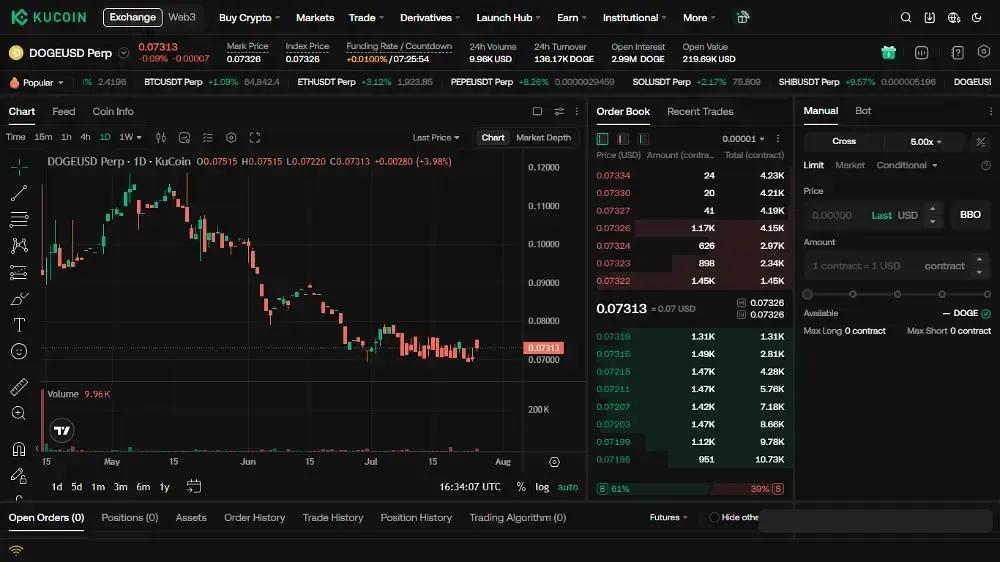
KuCoin closes the list as the gentlest introduction to coin-margined trading. Its COIN-M contracts on BTC and ETH sit inside an interface stripped of the density that makes professional derivatives platforms intimidating, with small contract sizes keeping the entry barrier low.
That accessibility is the whole proposition. Position sizing, margin display, and liquidation warnings are presented plainly, and the demo environment lets you rehearse the inverse payout curve before committing real collateral. For a spot trader taking a first step into crypto-settled derivatives, the learning curve is the shortest here.
The limits arrive quickly. Inverse coverage stops at the two majors, order books run thinner than the top of this list, and advanced traders will find the tooling sparse. Treat it as a training ground rather than a destination for size.
Pros
- Simplest interface and onboarding for first-time coin-margined traders.
- Small contract sizes keep the capital barrier genuinely low.
- Demo environment allows rehearsal before committing real collateral.
Cons
- Inverse coverage limited to BTC and ETH contracts only.
- Order book depth trails every platform above it here.
- Sparse advanced tooling for experienced derivatives traders.
Inverse vs USDT Perpetual Contracts Explained
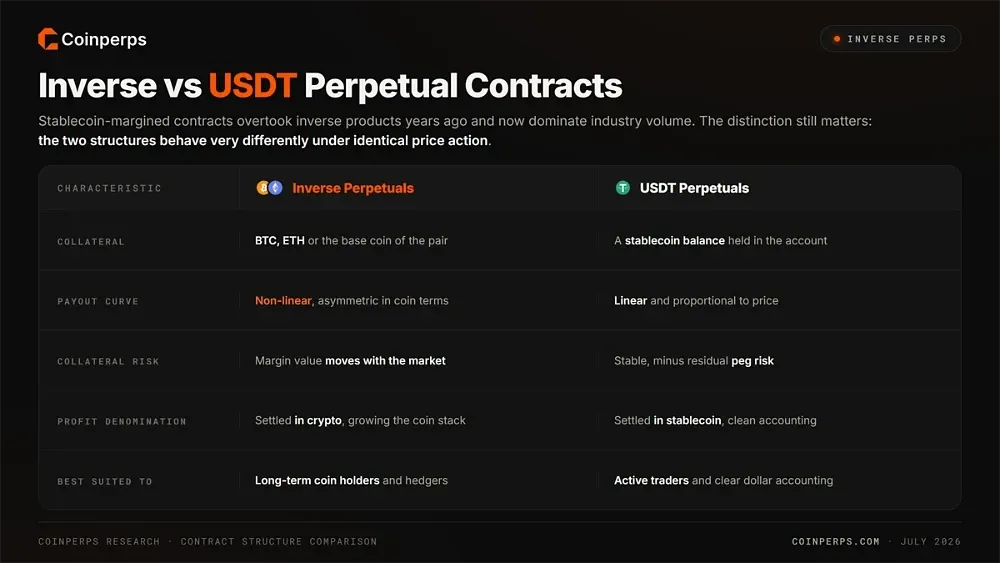
Stablecoin-margined contracts overtook inverse products years ago and now dominate trading volume across the entire industry. The distinction still matters because the two structures behave very differently under identical price action, and choosing the wrong one means spending the trade fighting your own collateral.
Linear vs Inverse Payoffs
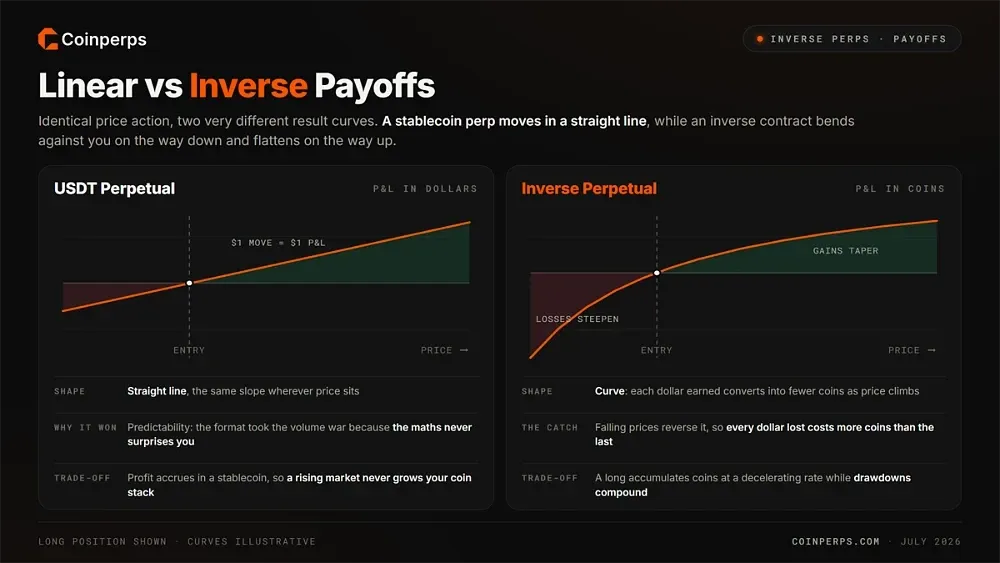
A stablecoin perpetual moves in a straight line, where every dollar of price movement produces exactly one dollar of profit or loss regardless of where price sits. That predictability is why the format won the volume war and why most traders never look further.
Inverse contracts curve instead. As price climbs, each dollar earned converts into fewer coins, so a long position accumulates crypto at a decelerating rate. Falling prices reverse the effect, with each dollar lost costing more coins than the last, which compounds drawdowns in collateral terms.
Collateral Stability
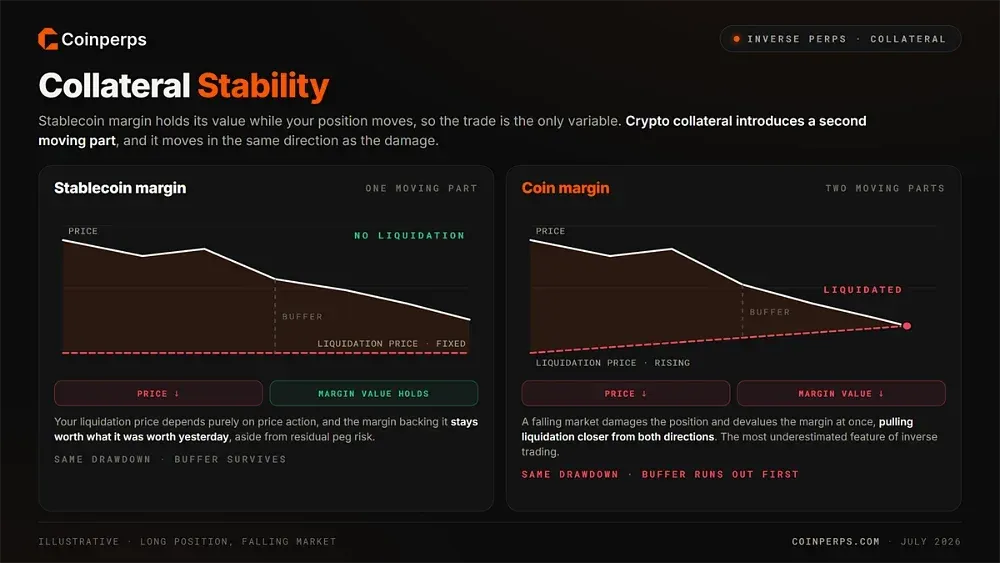
Stablecoin margin holds its value while your position moves, meaning the only variable you track is the trade itself. Your liquidation price depends purely on price action, and the margin backing it stays worth what it was worth yesterday, aside from residual peg risk.
Crypto collateral introduces a second moving part. A falling market damages your position and devalues the margin supporting it simultaneously, pulling the liquidation price closer from both directions at once. That double exposure is the single most underestimated feature of inverse
trading.
Market Exposure
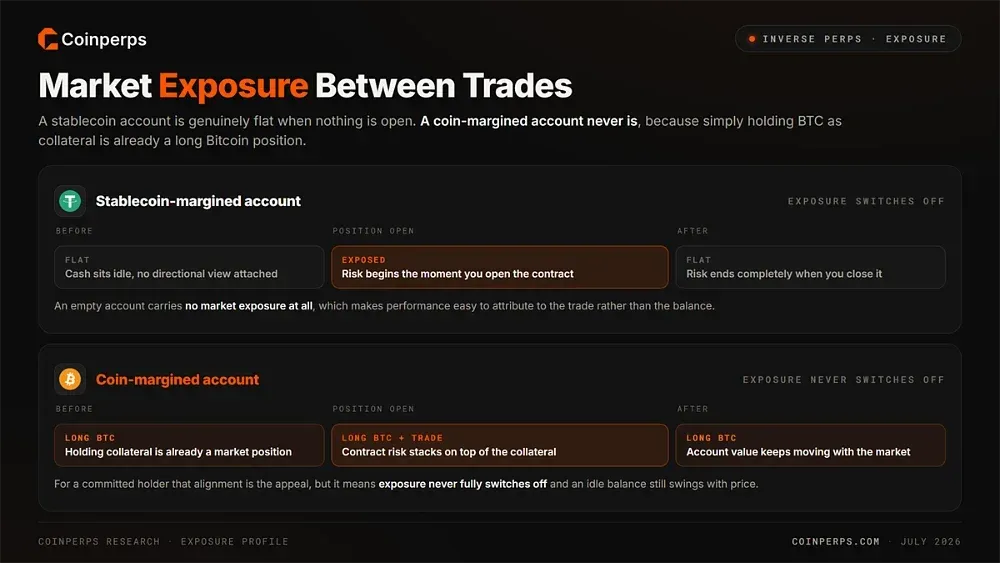
Holding stablecoin margin means carrying no market exposure between trades, so an empty account is genuinely flat and cash sits idle without a directional view attached. Risk begins only when you open a position and ends completely when you close it.
Coin-margined accounts are never flat. Simply holding BTC as collateral is a long Bitcoin position, so your account value fluctuates whether or not a contract is open. For a committed holder that alignment is the appeal, but it means exposure never fully switches off.
How to Choose an Inverse Perpetual Exchange
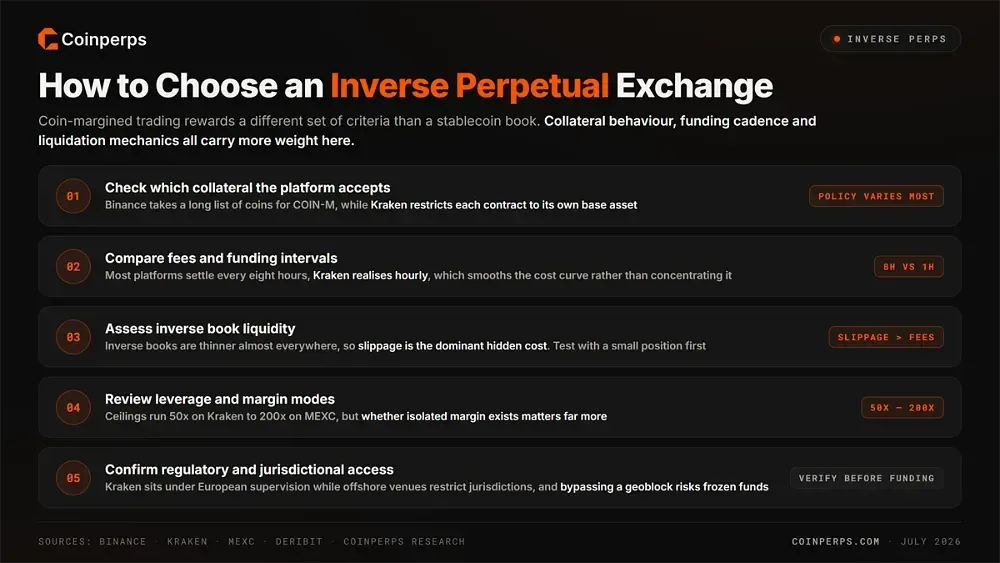
Picking a platform for coin-margined trading rewards a different set of criteria than a stablecoin book does, because collateral behaviour, funding cadence, and liquidation mechanics all carry considerably more weight here. Work through these five checks carefully before you deposit anything.
Check Which Collateral the Platform Accepts
Collateral policy varies more than any other feature. Binance accepts a long list of coins for its COIN-M contracts, while Kraken restricts each inverse contract to the base asset of that pair alone, so a BTC contract demands BTC margin specifically.
Match that policy against what you actually hold. If your portfolio sits in an asset the platform will not accept, you face a conversion that defeats the tax and exposure reasons most traders choose inverse contracts in the first place.
Compare Fees and Funding Intervals
Trading fees matter, but funding cadence often costs more over a held position. Most platforms settle every eight hours while Kraken realises hourly, and shorter intervals smooth the cost curve rather than concentrating it into scheduled windows you can be caught by.
Check the live rate before entering rather than assuming a market average applies. Our funding rate tracker shows current levels across platforms, and opening a position just before a high settlement can easily cost more than the round-trip commission on the trade.
Assess Inverse Book Liquidity
Inverse order books are thinner than their stablecoin equivalents almost everywhere, which makes slippage the dominant hidden cost. A platform advertising a marginally lower fee is a false economy if its book cannot absorb your size without moving the price against you.
Test with a small position before committing real capital. Watch how the spread behaves on the specific pair you intend to trade rather than the headline BTC book, since depth degrades sharply on secondary inverse pairs across every platform here.
Review Leverage and Margin Modes
Leverage ceilings range from 50x on Kraken to 200x on MEXC, but the more useful question is whether the platform offers isolated margin. Isolating collateral to a single position prevents one bad trade from consuming the entire crypto balance backing your account.
Cross margin looks efficient until a drawdown pulls unrelated positions into the liquidation cascade, an effect that falling collateral value accelerates further. Understanding how each platform handles liquidation before you actually need that knowledge is worth more than any leverage number.
Confirm Regulatory and Jurisdictional Access
Access varies sharply by country and changes frequently, particularly where derivatives products are concerned. Kraken operates under European supervision while the offshore platforms here restrict several jurisdictions outright, and using any workaround to bypass a geoblock risks having your funds frozen entirely.
Verify your own eligibility before funding rather than after the fact, and factor in any local tax reporting obligations. Our perpetual exchange regulation explainer covers how these rules land across the different platform types and where the regulatory perimeter currently sits.
Guide to Trading Inverse Perpetuals on Bybit
Trading an inverse contract from a standing start takes longer than a linear one, mostly because the collateral step and the margin settings both differ meaningfully.
Follow these ten steps from registration through to closing your position:
- Create account: Register on Bybit with an email or phone number, set a strong password, and enable two-factor authentication before you move any funds into the account.
- Verify identity: Submit identity documents to lift withdrawal limits and unlock derivatives access, since inverse contracts sit behind verification on most tiers and regional requirements vary.
- Deposit collateral: Send the coin you intend to margin with, such as BTC, to your Funding Wallet, choosing the cheapest available network for that asset to keep deposit costs down.
- Transfer funds: Move the deposited coin from your Funding Wallet into the Unified Trading Account, because derivatives positions cannot draw margin directly from a funding balance.
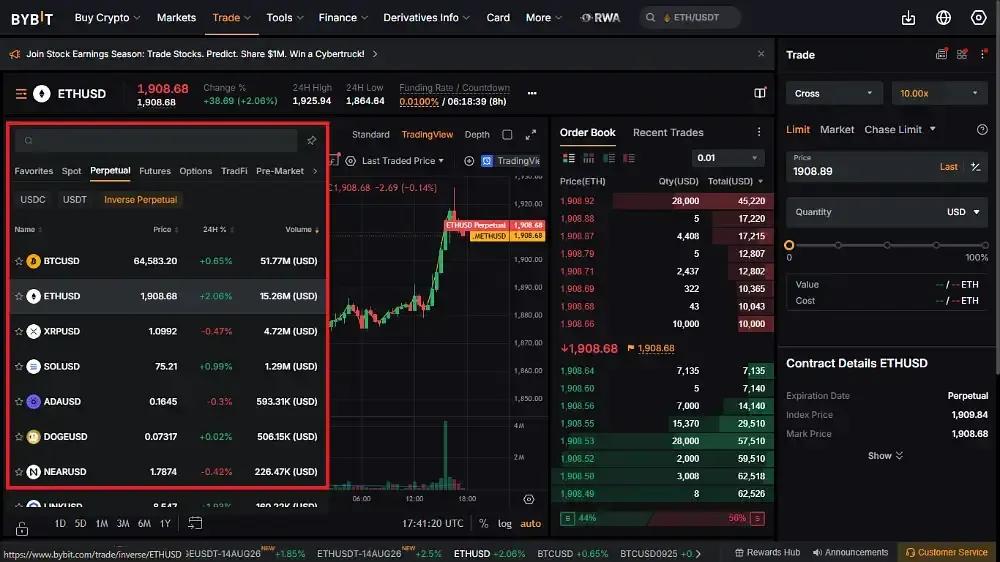
- Open derivatives: Navigate to Derivatives and select the Inverse Perpetual category, rather than the USDT-margined list that the platform displays by default when the page first loads.
- Select pair: Choose a contract such as BTCUSD and confirm the quote currency reads USD rather than USDT, which is what distinguishes inverse from linear contracts.
- Set margin: Choose isolated margin over cross for a first position, then set leverage conservatively, remembering that your collateral value falls alongside price during any drawdown.
- Size position: Enter your size in USD contract terms, then check the estimated liquidation price and required margin, both displayed in coin terms, before going further.
- Place order: Submit a limit order to capture maker pricing where possible, or a market order for immediate fill, then confirm the position appears under Positions.
- Close position: Exit through Close Position or a pre-set take-profit and stop-loss, remembering that the realised gain settles into your coin balance rather than in dollars.
Worth noting that Bybit displays position value in dollars while settling in crypto, so the profit figure on screen converts to fewer coins as price rises. Checking the coin-denominated column rather than the dollar figure keeps expectations aligned with what actually lands in your balance.
Pros and Cons of Inverse Perpetuals
Coin-margined contracts solve genuine problems for some traders while creating unnecessary complexity for others. The split usually comes down to whether you naturally think in coins or in dollars, and both sides below deserve honest weight before you commit any capital.
Pros
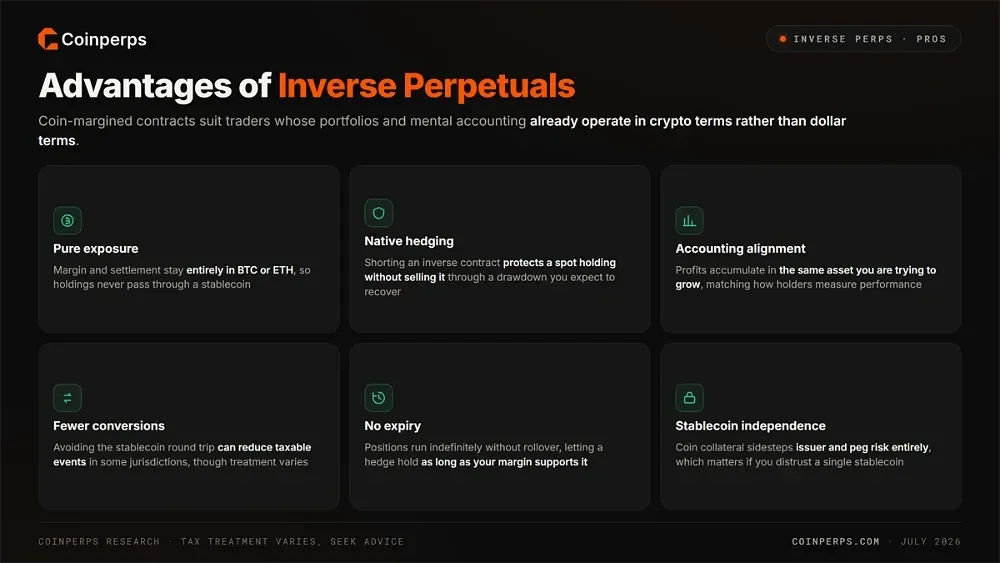
Inverse contracts suit traders whose portfolios and mental accounting already operate in crypto terms rather than dollar terms.
The advantages that matter most are:
- Pure exposure: Positions margin and settle entirely in BTC or ETH, so you never convert holdings into stablecoins to access leveraged derivatives exposure.
- Native hedging: Shorting an inverse contract protects a spot holding without selling the underlying asset, preserving your position through a drawdown you expect to recover.
- Accounting alignment: Profits accumulate in the same asset you are trying to grow, which matches how long-term holders actually measure portfolio performance over time.
- Fewer conversions: Avoiding the stablecoin round trip can reduce taxable events in some jurisdictions, though treatment varies and professional advice is worth seeking.
- No expiry: Positions remain open indefinitely without rollover, letting a hedge or directional view run as long as your margin supports it.
- Stablecoin independence: Coin collateral sidesteps issuer and peg risk entirely, which matters to traders wary of concentrating exposure in a single stablecoin.
Cons
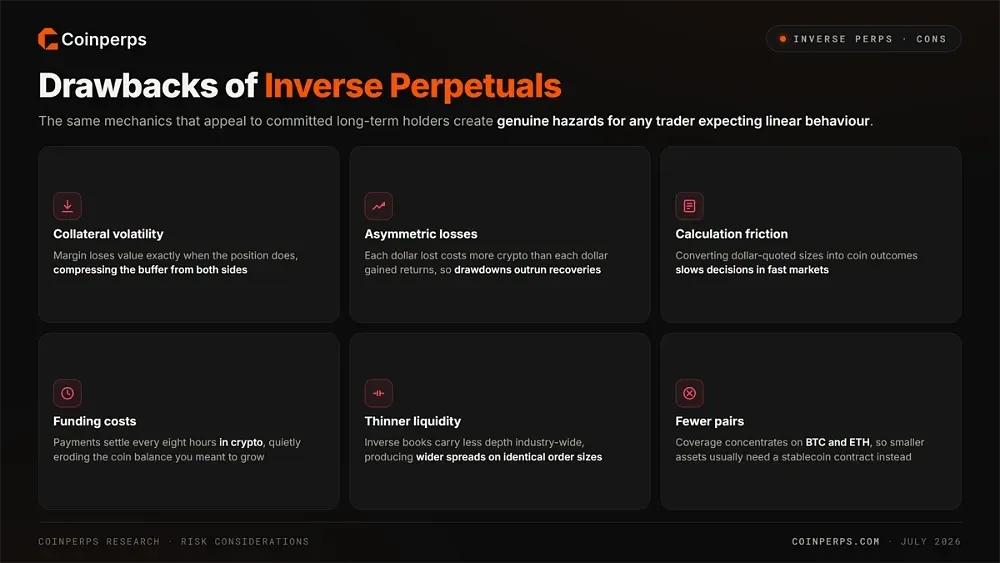
The same mechanics that appeal to committed long-term holders create genuine hazards for any trader expecting linear behaviour.
The drawbacks to weigh carefully are:
- Collateral volatility: Your margin loses value exactly when your position does, compressing the liquidation buffer from both sides during any sharp market decline.
- Asymmetric losses: The inverse curve means each dollar lost costs more crypto than each dollar gained returns, so drawdowns consume collateral faster than recoveries rebuild it.
- Calculation friction: Converting between dollar-quoted contract sizes and coin-denominated outcomes adds mental overhead that slows decisions during fast-moving markets.
- Funding costs: Payments settle every eight hours on most platforms and accrue in crypto, quietly eroding a coin balance you intended to grow through the position.
- Thinner liquidity: Inverse books carry less depth than stablecoin equivalents industry-wide, producing wider spreads and more slippage on identical order sizes.
- Fewer pairs: Coverage concentrates on BTC and ETH across most platforms, so expressing views on smaller assets usually requires a stablecoin-margined contract instead.
Understanding the Fees for Inverse Perpetuals
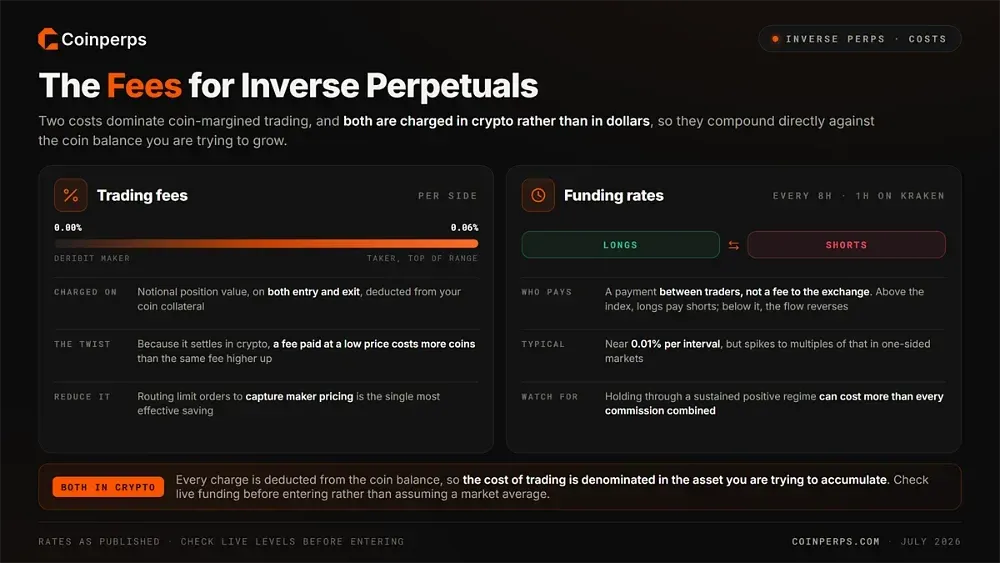
Two costs dominate coin-margined trading, and both are charged in crypto rather than in dollars, which means they compound directly against the coin balance you are trying to grow. Understanding each of them separately is what keeps the total bill predictable.
Trading Fees
Commissions apply on both entry and exit, calculated against notional position value and deducted from your coin collateral. Base rates across the platforms here run from a zero percent maker fee on Deribit to roughly 0.06% taker at the higher end of the range.
Because charges settle in crypto, a fee paid at a low price costs more coins than the identical fee at a higher one. Routing limit orders to capture maker pricing is the single most effective reduction, and our lowest fee perpetual exchanges guide compares the full range.
Funding Rates
Funding is a payment exchanged directly between long and short traders to keep the contract tethered to spot, not a fee collected by the exchange. When the perpetual trades above the index, longs pay shorts, and the flow reverses when it trades below.
Rates typically hover near 0.01% per interval but spike hard during one-sided markets, occasionally reaching multiples of that level. Most platforms settle every eight hours while Kraken realises hourly, and holding through a sustained positive regime can cost more than every commission combined.
Risks and Considerations
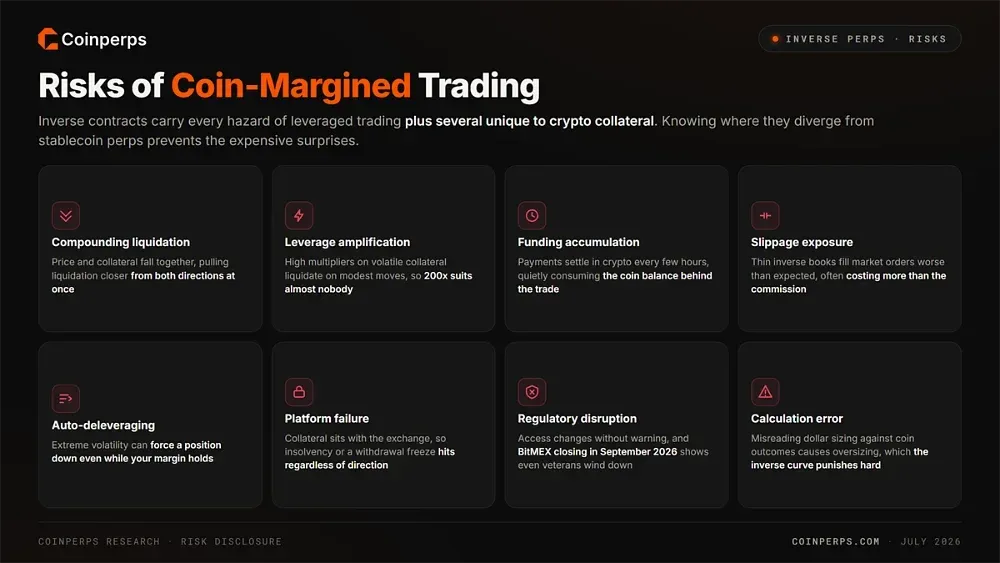
Coin-margined contracts carry every hazard of leveraged trading plus several unique to crypto collateral. Understanding where they differ from stablecoin perpetuals prevents the most expensive surprises.
The risks worth weighing before you trade are:
- Compounding liquidation: Falling prices damage your position and your collateral simultaneously, pulling the liquidation price closer from both directions faster than linear intuition suggests.
- Leverage amplification: High multipliers on already volatile collateral produce liquidations on modest moves, and the 200x ceilings advertised are unsuitable for almost every retail account.
- Funding accumulation: Payments settle in crypto every few hours, so a long-held position can quietly consume a meaningful share of the coin balance backing it.
- Slippage exposure: Thinner inverse books mean market orders fill worse than expected, an implicit cost that frequently exceeds the commission on the same trade.
- Auto-deleveraging: Extreme volatility can force position reduction even when your margin holds, a mechanic our auto-deleveraging guide explains in full.
- Platform failure: Collateral sits with the exchange, so insolvency, withdrawal freezes, or security breaches put your crypto at risk independent of market direction.
- Regulatory disruption: Access changes without warning, and BitMEX closing in September 2026 demonstrates that even long-established platforms can wind down operations entirely.
- Calculation error: Misreading dollar-quoted sizing against coin-denominated outcomes leads to accidental oversizing, a mistake the inverse payout curve punishes disproportionately.
Bottom Line
Inverse perpetuals are a specialist instrument that solves a specific problem: staying fully invested in crypto while accessing leverage and the ability to short. If you measure your portfolio in coins rather than dollars, that alignment is worth the added complexity.
For most traders, Bybit offers the best combination of inverse depth and usable margin tooling, while Binance wins on collateral breadth and Kraken on regulatory standing. Match the platform to what you hold and where you live rather than to a leverage number.
Above all, respect the collateral. The mechanic that makes these contracts appealing, margin denominated in the asset you are trading, is the same one that accelerates losses when the market turns. Size conservatively, watch funding, and verify your platform serves your jurisdiction before depositing.
FAQs
