Lighter DEX Statistics & Trends for 2026
Find out Lighter's numbers in one place from monthly volume, open interest, TVL, funding rounds & how the zero-fee perp DEX actually earns revenue.

- Lighter scaled faster than any zero-fee exchange before it. Monthly perpetual volume peaked at $232 billion in the same month the LIT token launched.
- Zero retail fees still produced top-four revenue. Premium accounts and a share of USDC interest generated more than $45 million over one year.
- The post-airdrop reset is the defining trend. Once points farming ended, volume and open interest fell sharply, as did the LIT price.
In less than a year, Lighter rose to second place in perpetual DEX usage. Within months of its token launch, it had also surrendered most of that volume. The data makes both phases clear.
This page examines the main Lighter statistics for 2026: its volume cycle and open interest, the revenue model, LIT token, venture backing, and underlying infrastructure. Figures are drawn from DefiLlama, protocol documentation, and primary reporting.
For live data across the category, visit our Perp DEX Aggregator page.
Top 7 Lighter DEX Statistics & Trends (2026)
Together, these seven statistics follow Lighter from its incentive-driven surge through the token launch and into the more normalised market that came afterward. Each highlights a different part of the protocol's trajectory.
1. Monthly Volume Peaked at $232 Billion Before an 83% Reset
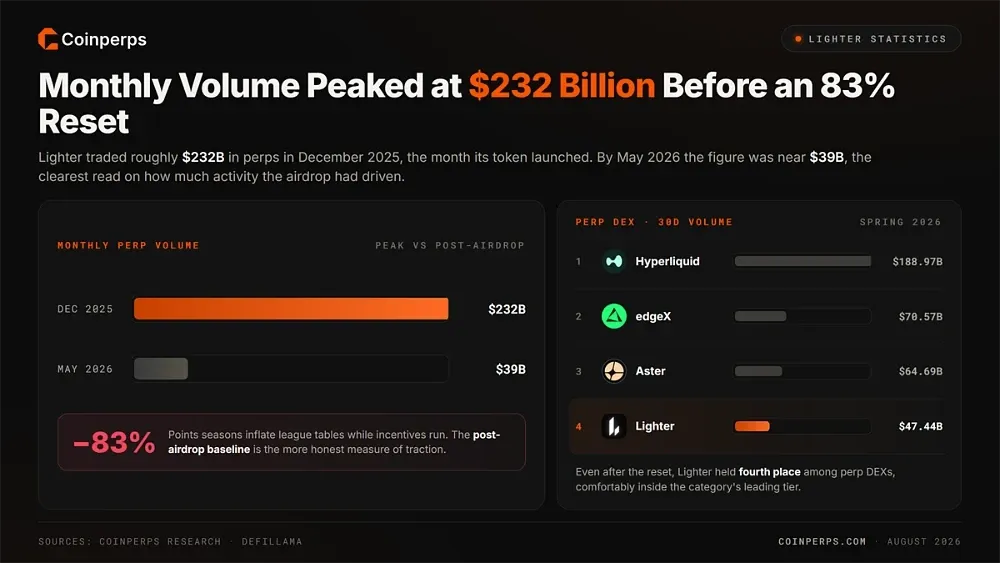
Lighter recorded roughly $232 billion in perpetual volume in December 2025, the month its token launched. By May 2026, monthly volume had dropped to around $39 billion. The 83% decline offers the clearest indication of how much activity had been driven by airdrop participation.
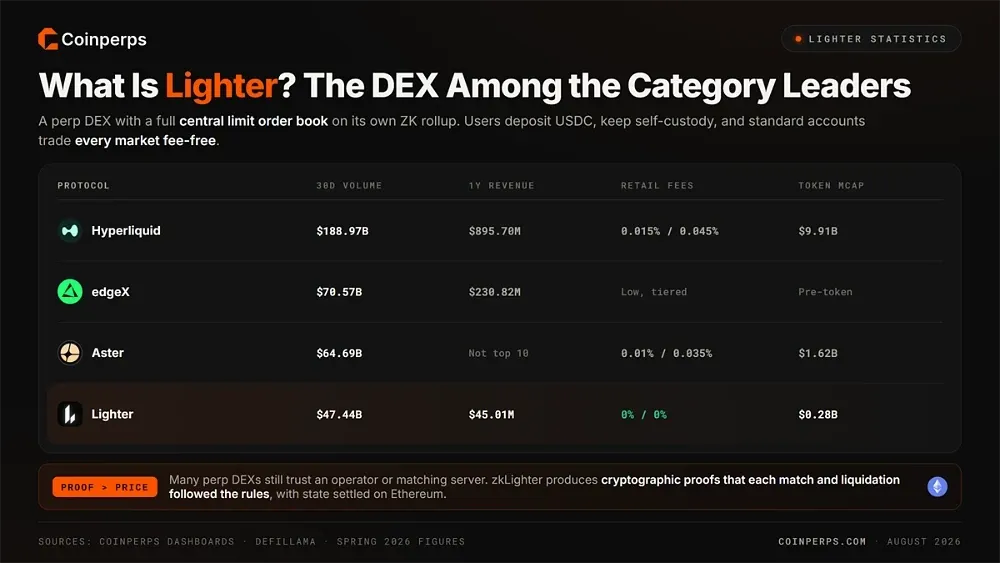
Even after that reset, Lighter remained one of the largest onchain books. Coinperps' decentralized perpetual futures statistics ranked it fourth among perp DEXs in spring 2026, with $47.44 billion in 30-day volume. Only Hyperliquid, edgeX, and Aster ranked higher, leaving Lighter comfortably within the category's leading tier.
That shift also matters when reading perp DEX league tables. Points seasons can inflate trading activity while incentives are running. Lighter's post-airdrop baseline therefore provides the more honest measure of traction, and maintaining a top-four position at that level is the more impressive statistic.
2. Zero Retail Fees Still Produced $45 Million in Annual Revenue
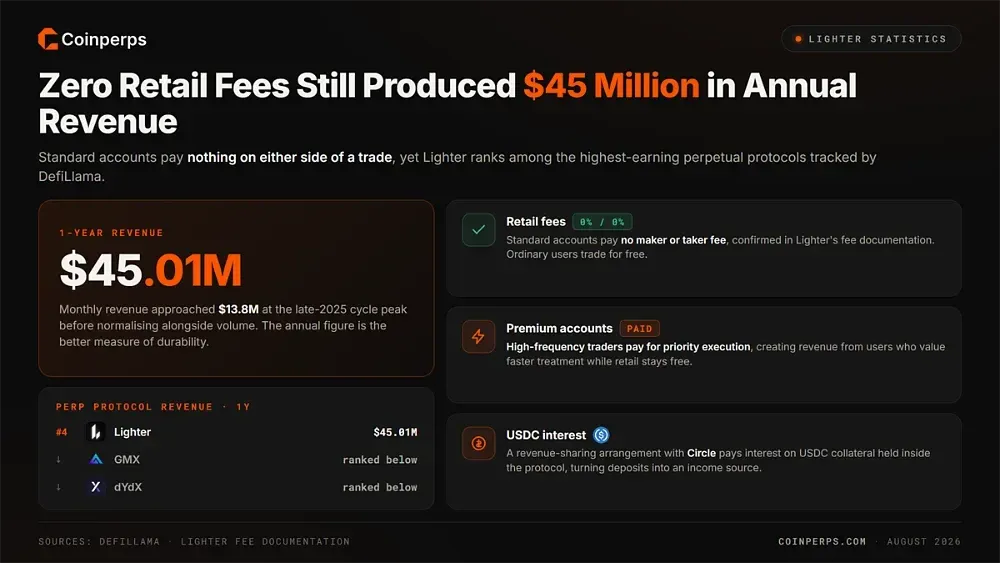
Lighter’s zero-fee model did not prevent it from becoming one of the highest-earning perpetual protocols, with revenue reaching $45.01 million over one year tracked by DefiLlama.
The revenue model and supporting figures break down like this:
- Retail fees: Standard accounts pay nothing on either side of a trade, as confirmed in Lighter’s fee documentation, leaving ordinary users with zero trading fees.
- Premium accounts: High-frequency traders pay for priority execution, creating revenue from users who value faster treatment while standard retail trading remains free.
- USDC interest: A revenue-sharing arrangement with Circle pays interest on USDC collateral held inside the protocol, turning deposited collateral into another income source.
- Revenue ranking: DefiLlama’s revenue rankings credit Lighter with $45.01 million over one year, fourth among perpetual protocols and ahead of GMX and dYdX.
- Cycle peak: Monthly revenue approached $13.8 million in late 2025 before normalising alongside volume, making the annual figure the more meaningful measure of durability.
3. Open Interest Reached $1.7 Billion at the Cycle High
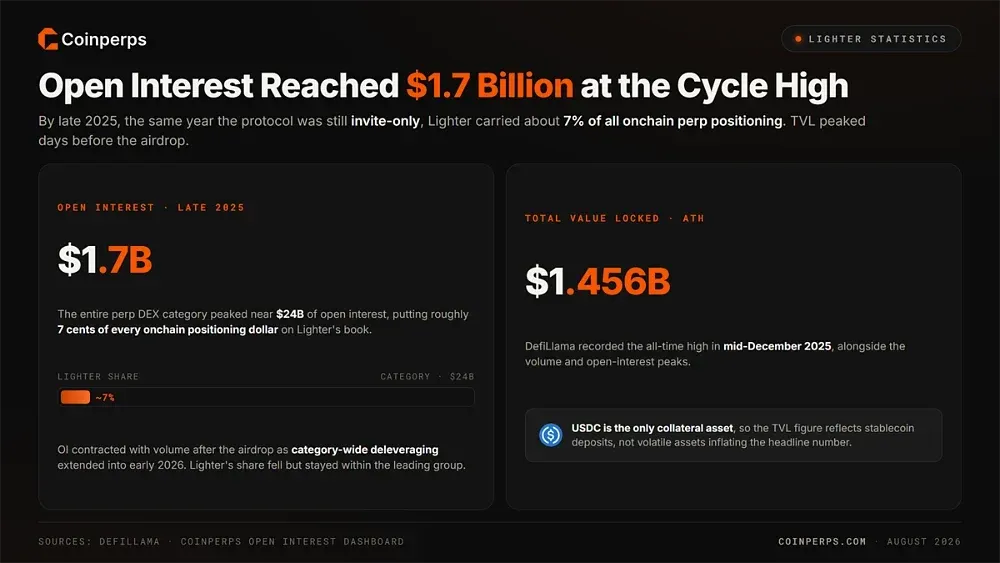
By late 2025, Lighter's open interest had climbed to roughly $1.7 billion, despite the protocol having been invite-only earlier that year. The entire perp DEX category peaked near $24 billion, giving Lighter about 7% of all onchain positioning at the time.
Total value locked moved along a similar curve. DefiLlama recorded an all-time high of $1.456 billion in mid-December 2025. Because USDC is the protocol's only collateral asset, that total reflects stablecoin deposits rather than a mix of volatile assets boosting the headline figure.
Open interest and TVL both contracted with volume after the airdrop as category-wide deleveraging extended into early 2026. Our open interest dashboard tracks positioning across the sector. Lighter's current share is well below its December peak, although it remains firmly within the leading group.
4. The LIT Airdrop Distributed 25% of Supply With No Vesting
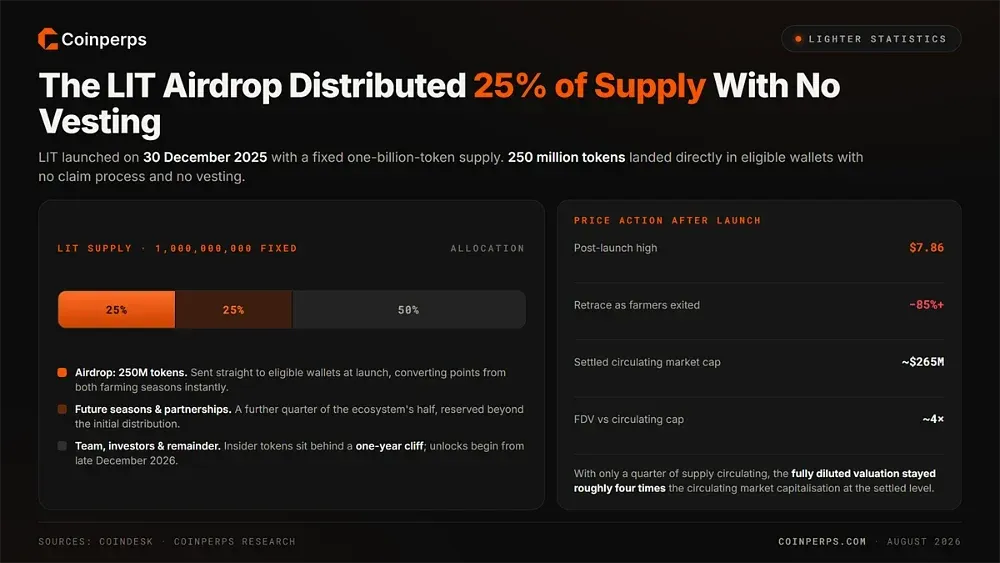
LIT launched on 30 December 2025 with a fixed one-billion-token supply, and CoinDesk reported that 250 million tokens went directly to eligible wallets at launch.
The allocation and early market reaction broke down as follows:
- Airdrop: The 250 million tokens represented 25% of supply, arrived with no claim process or vesting, and converted points from both farming seasons instantly.
- Ecosystem allocation: Half the supply belongs to the ecosystem, including another quarter reserved for future seasons and partnerships beyond the initial distribution.
- Insider unlocks: Team and investor tokens sit behind a one-year cliff, with unlocking scheduled to begin from late December 2026.
- Price action: LIT touched $7.86 after launch, then retraced more than 85% as farmers exited, settling near a $265 million circulating market cap.
- Valuation gap: At that settled level, LIT’s fully diluted valuation remained around four times higher than its circulating market capitalisation.
5. Lighter Raised $68 Million at a $1.5 Billion Valuation
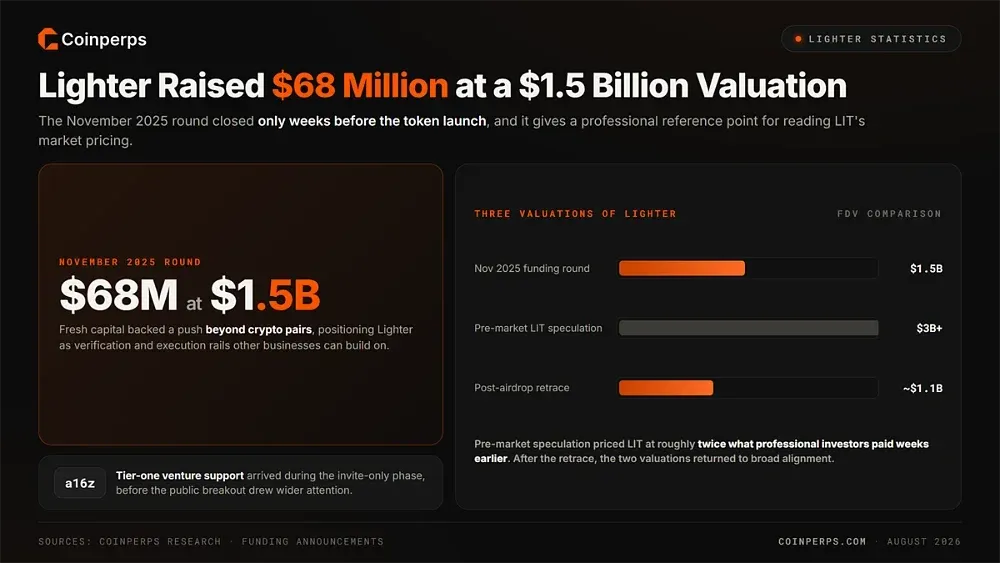
A November 2025 funding round brought in $68 million at a $1.5 billion valuation, only weeks before the token launch. Lighter had already received backing from a16z during its invite-only phase, giving the protocol tier-one venture support before its public breakout drew wider attention.
The funding valuation also provides a useful reference point for LIT. Pre-market speculation pushed the token's fully diluted valuation above $3 billion, roughly twice the level professional investors had paid only weeks earlier. After the post-airdrop retrace, the two valuations returned to broad alignment.
Fresh capital also supported the roadmap that came next. Rather than focusing only on competing for perpetual exchange volume, Lighter began pushing beyond crypto pairs into broader trading infrastructure, positioning itself as verification and execution rails that other businesses could build on.
6. Robinhood Chain Brought an 11 Million LIT Incentive Programme
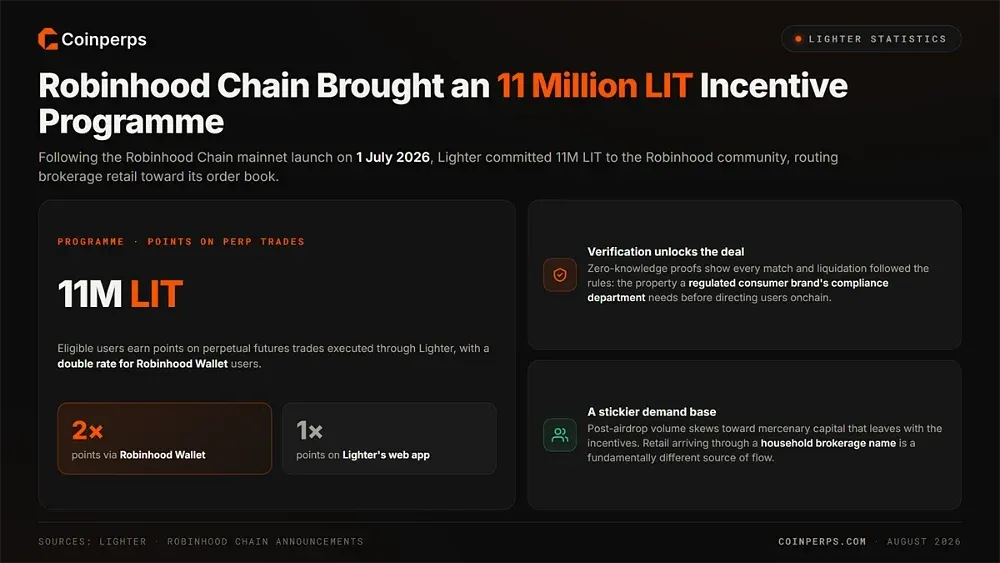
Following the Robinhood Chain mainnet launch on 1 July 2026, Lighter committed 11 million LIT tokens to the Robinhood community. Eligible users earn points on perpetual futures trades through Lighter, with a 2x rate through Robinhood Wallet versus 1x on Lighter's web application.
Verification is central to that strategy. Lighter's zero-knowledge architecture proves that every match and liquidation followed the protocol's rules. For a regulated consumer brand with a compliance department, that property matters when directing users toward onchain derivatives infrastructure the company does not control.
It also changes the potential source of future activity. After an airdrop, perp DEX volume can skew toward mercenary capital that moves elsewhere as soon as incentives disappear. Retail traders arriving through a household brokerage name represent a fundamentally different and potentially stickier demand base.
7. The zkLighter Rollup Processes Up to 15,000 TPS With Verifiable Matching
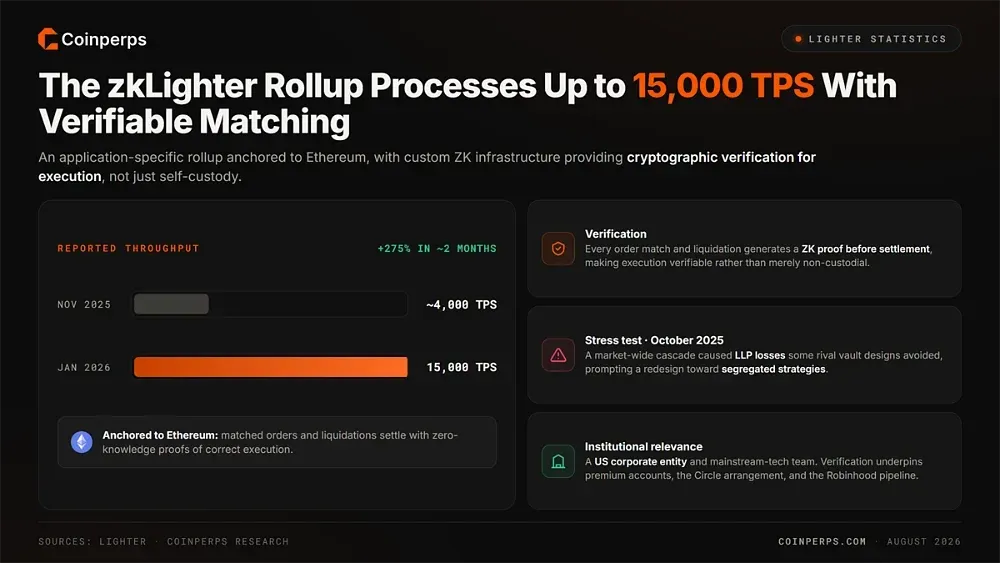
zkLighter is an application-specific rollup anchored to Ethereum, with reported throughput rising from around 4,000 transactions per second in November 2025 to 15,000 transactions per second by January 2026. Its custom ZK infrastructure provides cryptographic verification for execution.
Its design shows up most clearly in three practical areas:
- Verification: Every order match and liquidation generates a zero-knowledge proof before settlement, making execution verifiable rather than merely non-custodial.
- Stress test: In October 2025, a market-wide cascade caused LLP losses that some rival vault designs avoided, prompting Lighter to redesign toward segregated strategies.
- Institutional relevance: The protocol’s US corporate entity and mainstream-technology team help explain institutional interest, while verification underpins premium accounts, Circle arrangement, and Robinhood pipeline.
What Is Lighter?
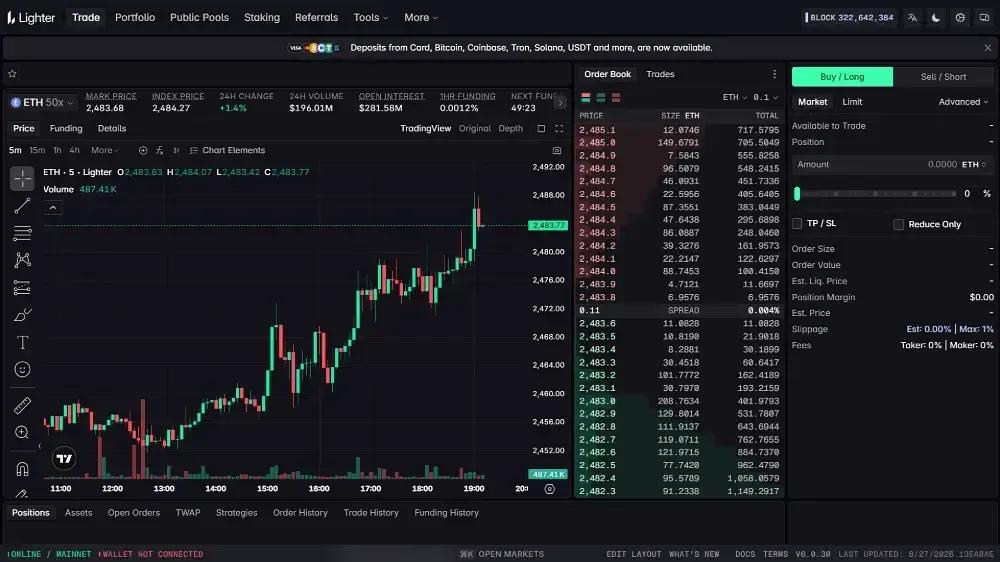
Lighter is a decentralized perpetual futures exchange with a full central limit order book running on its own zero-knowledge rollup. Users connect a wallet and deposit USDC while retaining self-custody. Standard accounts can then trade any market without maker or taker fees.
The protocol was founded by engineers from mainstream technology companies and operates through a US corporate entity, which is unusual in a category largely dominated by offshore foundations. Its investors include a16z, and the November 2025 funding round brought total disclosed funding to $68 million.
Proof, rather than price alone, is the main technical differentiator. Many perp DEXs still require users to trust an operator or matching server. zkLighter instead produces cryptographic proofs showing that each match and liquidation followed the rules, with the resulting state settled on Ethereum.
Compared with the category leaders, like Hyperliquid and Aster, Lighter competes primarily on cost and verifiability rather than broad range of markets.
How to Trade on Lighter
Moving from an empty wallet to an open position takes only a few minutes, but every stage affects margin and liquidation risk. Follow these eight steps:
- Create a wallet: Set up a compatible wallet such as MetaMask, store the recovery phrase offline, and keep the keys away from any trading device.
- Fund with USDC: Acquire USDC and enough gas for the source chain. Lighter accepts USDC as its sole collateral asset.
- Bridge to Lighter: Open the app and connect your wallet, then deposit USDC through the bridge into the zkLighter rollup.
- Enable trading: Sign the account approval that allows the protocol to create your trading account and route orders through its proven matching engine.
- Choose a market: Select a perpetual pair and check market depth along with the funding rate before committing. Lighter samples funding hourly.
- Set size and margin: Choose the position size and margin mode. Before submitting, compare the displayed liquidation price with your risk tolerance.
- Place the order: Submit either a limit or market order and confirm the fill. Standard accounts are charged no trading fee in either case.
- Monitor and close: Watch margin and hourly funding while the position remains open. When you are finished, close it and withdraw collateral back through the bridge.
Is Lighter Safe?
Lighter reduces some familiar risks while concentrating others. Self-custody removes exposure to an exchange balance sheet. Its zero-knowledge architecture also makes matching and liquidations provably correct rather than matters of trust, providing a stronger guarantee than most competing protocols offer.
Its operating history still includes a genuine stress event. During the October 2025 cascade, LLP depositors directly absorbed losses in the pool. That incident led to the segregated-strategy redesign and shows that providing liquidity on Lighter involves risks that ordinary trading does not.
Regulation remains another open issue. Lighter is not authorised in the EEA or most regulated markets, which leaves eligibility, compliance, and reporting responsibilities with the user. That tradeoff is common across the category rather than unique to Lighter.
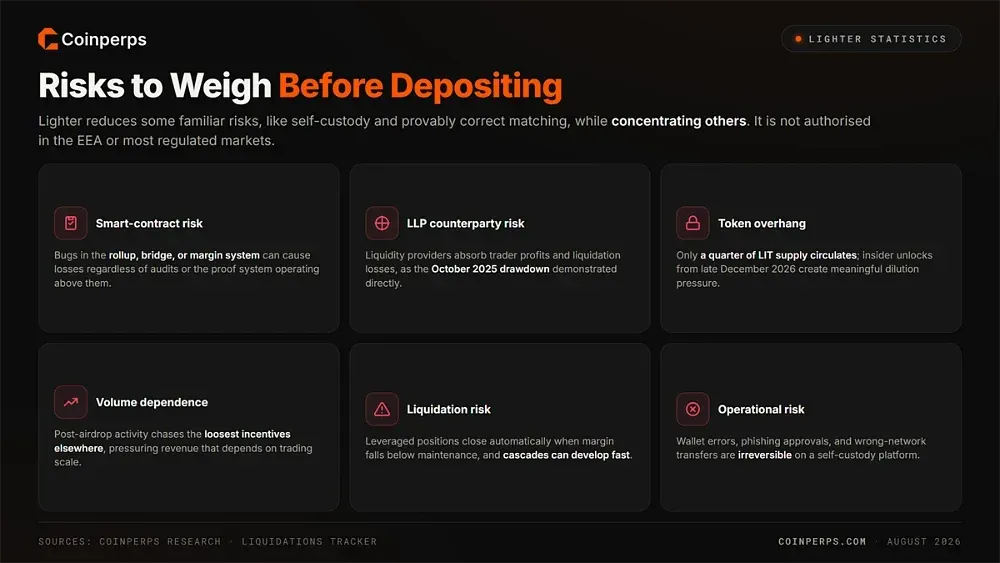
Risks to Weigh Before Depositing
- Smart-contract risk: Bugs in the rollup, bridge, or margin system can cause losses regardless of audits or the proof system operating above them.
- LLP counterparty risk: Liquidity providers absorb trader profits and liquidation losses on the other side of the market, as the October 2025 drawdown demonstrated.
- Token overhang: Only one quarter of LIT supply is circulating, while insider unlocks beginning in late December 2026 create meaningful future dilution pressure.
- Volume dependence: After an airdrop, activity can shift toward whichever protocol offers the loosest incentives, putting pressure on revenue that depends on trading scale.
- Liquidation risk: Leveraged positions are closed automatically when margin falls below maintenance requirements. Our liquidations tracker shows how quickly cascades can develop.
- Operational risk: Wallet errors, phishing approvals, and transfers over the wrong network remain irreversible mistakes with no recourse on a self-custody platform.
Where Is Lighter Regulated?
Decentralization does not make Lighter universally available. Under its current Terms of Service, the platform excludes users and entities in the United States, Canada, United Kingdom, China, North Korea, Russia, Ukraine, Cuba, Iran, Venezuela, and Syria through the company-hosted interface and API.
In Europe, perpetual futures sit outside the simpler spot-crypto framework. ESMA said in February 2026 that leveraged products marketed as perpetual futures may fall under national CFD product-intervention rules, depending on their specific characteristics within the European Union's regulatory framework.
When those products qualify as CFDs, the rules can include leverage limits, margin close-out requirements, negative balance protection, mandatory risk warnings, and restrictions on incentives. Eligibility therefore depends on both Lighter’s own access rules and the derivatives regulations applying in each jurisdiction.
Bottom Line
Lighter demonstrated that a zero-fee perpetual exchange can reach the top tier of a fiercely competitive category while still funding itself. Its verification-first architecture is the underlying product, and the Robinhood pipeline points toward the direction that product is taking.
Durability is now the unresolved question. The post-airdrop decline revealed how much of the earlier surge came from incentive-driven capital. Lighter still needs to turn its engineering credibility into trading volume that remains without a points season supporting it.
Methodology
This page combines dashboard figures, market trackers, and official documentation, applying the same recurring metrics used throughout our category statistics to measure Lighter.
- DefiLlama: Source for 30-day volume rankings, one-year revenue, open interest, and TVL history.
- CoinGecko: Source for LIT price, circulating supply, and market-cap references.
- CoinDesk: Source for reporting on the token launch and airdrop distribution.
- Lighter documentation: Source for fee structure, account tiers, and protocol design claims.
- Primary reporting: Source for the funding rounds, Robinhood Chain programme, and October 2025 LLP incident.
FAQs
