Crypto Perps vs Spot Trading Explained
Perpetual contracts let you trade crypto prices with leverage, spot trading makes you an owner. We break down fees, risks, taxes, and how to choose in 2026.

- Ownership vs speculation: Spot trading hands you the actual coins to hold, stake, or move, while perpetual contracts only give you exposure to the price.
- Leverage and liquidation: Perps let you multiply a position up to 500x or more, which introduces liquidation risk and funding costs that spot trading never carries.
- Costs and reporting: Perp traders pay funding on top of commissions, and from 2026 both spot and perp activity on major exchanges is reported to tax authorities automatically.
Every crypto trader eventually faces the same fork in the road: buy the asset itself, or trade a contract that tracks it. The two paths can look identical on a price chart, yet they behave completely differently the moment leverage, funding, or a margin call enters the picture.
Spot trading is the direct route. You exchange one asset for another and walk away as the owner, free to hold through a decade or sell in an hour. Perpetual contracts are the synthetic route, letting you control a much larger position with borrowed exposure and profit from moves in either direction.
We trade both daily at Coinperps, and the difference in outcomes between the two is rarely about the chart. It comes down to mechanics like funding rates, liquidation prices, and fees.
This guide walks through each one so you can pick the route that fits your goals. 🔽
What are Crypto Perpetual (Perps) Contracts?
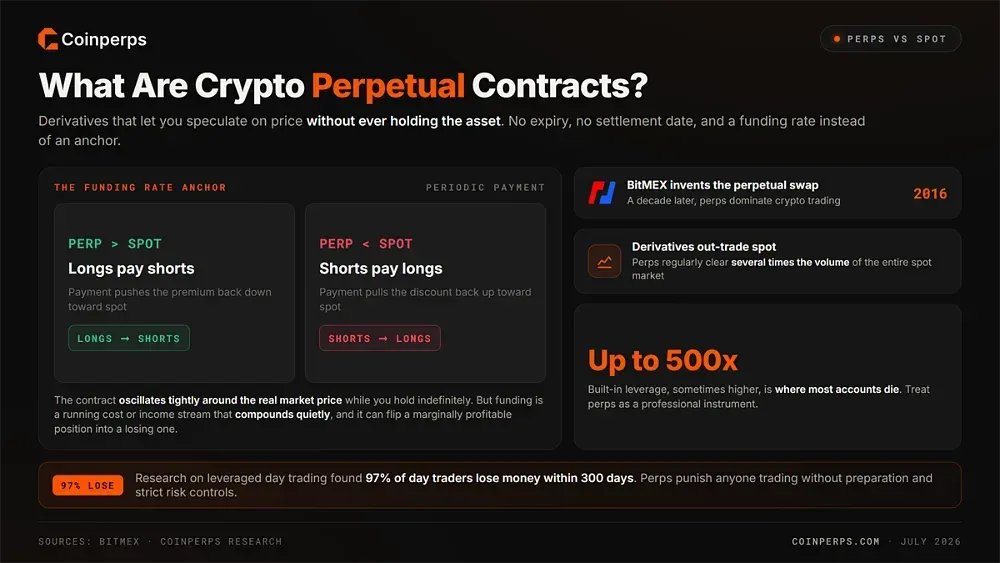
Perpetual contracts, usually shortened to perps, are crypto derivatives that let you speculate on an asset's price without ever holding it. BitMEX introduced the perpetual swap in 2016, and a decade later perps dominate crypto trading, with derivatives regularly clearing several times the volume of the entire spot market.
Unlike a traditional futures contract, a perp never expires, so there is no settlement date forcing its price back to spot. The anchor is the funding rate instead, a periodic payment swapped between traders. When the perp trades above spot, longs pay shorts; when it trades below, shorts pay longs.
That funding mechanism keeps the contract oscillating tightly around the real market price while letting you hold a position indefinitely. It also means holding a perp has a running cost or income stream that spot ownership never does, one that compounds quietly and can flip a marginally profitable position into a losing one.
Perps pair that mechanism with leverage, sometimes as high as 500x or more, which is where most accounts die. Research on leveraged day trading found that 97% of day traders lose money within 300 days, so treat perps as a professional instrument that punishes anyone trading without preparation and strict risk controls.
What is Crypto Spot Trading?
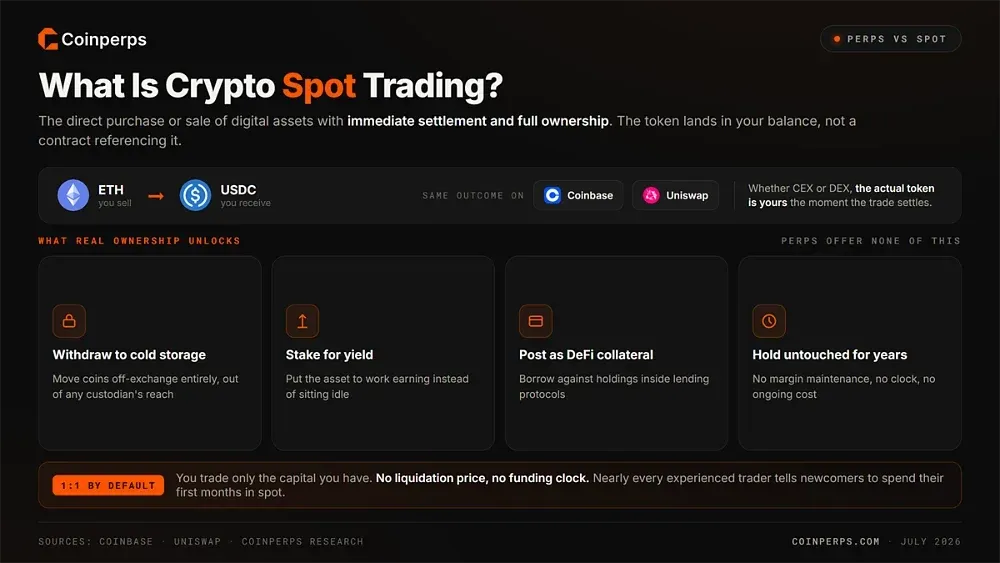
Crypto spot trading is the direct purchase or sale of digital assets with immediate settlement and full ownership. Whether you swap ETH for USDC on Coinbase or through a DEX like Uniswap, the outcome is identical: the actual token lands in your balance, not a contract referencing it.
Real ownership unlocks everything a token can do beyond price exposure. You can withdraw it to cold storage, stake it for yield, post it as DeFi collateral, or hold it untouched for years. A perpetual position offers none of that utility, since it exists only inside the exchange that issued it.
Spot trading also runs at 1:1 by default, meaning you trade only the capital you actually have. There is no liquidation price hanging over the position and no funding clock ticking against you, which is why nearly every experienced trader we know tells newcomers to spend their first months in spot before touching a derivative.
Differences Between Perpetual and Spot Trading
The core split is simple: spot makes you an owner, perps make you a speculator on price alone. Everything else, from leverage to liquidation to costs, flows from that single distinction, and the table below puts the two side by side before we unpack the details.
Feature | Spot Trading | Perpetual Contracts |
|---|---|---|
Ownership | You hold the actual asset | Synthetic exposure, no ownership |
Leverage | 1:1 by default | Commonly 20x to 500x or more |
Direction | Profit from rises only | Long or short with equal ease |
Expiry | None, hold forever | None, but funding accrues |
Ongoing Costs | None while holding | Funding every 1 to 8 hours |
Liquidation | Impossible | Constant risk under leverage |
Best Suited For | Investing and accumulation | Active trading and hedging |
Here is how each difference plays out in practice:
- Asset ownership: Spot purchases put the real coin in your wallet with full utility, while a perp is a derivative that never grants any claim on the underlying asset.
- Leverage access: Spot runs unleveraged unless you borrow, whereas perps offer built-in leverage reaching 500x on MEXC, multiplying both gains and losses dramatically.
- Trade direction: Spot only profits when prices rise, but perps let you short just as easily as you long, earning from declines without borrowing coins first.
- Settlement terms: Spot trades settle instantly and can be held forever at no cost, while perps never expire but demand ongoing margin maintenance and funding payments.
- Cost structure: Spot traders pay a commission per trade and nothing after, whereas perp traders pay commissions plus funding exchanged between longs and shorts continuously.
- Liquidation exposure: A spot position can never be force-closed no matter how far price falls, but a leveraged perp gets liquidated once margin runs out.
- Strategy fit: Spot suits accumulation, staking, and long horizons, while perps serve short-term speculation, hedging existing holdings, and strategies that need leverage or shorting.
Fee Structures in Spot vs Perpetual Trading
Fees decide your profitability more than most entries or exits do, and the two markets price very differently. Spot charges a simple commission per trade, while perps stack a lower commission on top of recurring funding, and the totals diverge sharply the longer a position stays open.
Cost Item | Typical Spot | Typical Perps |
|---|---|---|
Maker Fee | Around 0.1% on CEXs | 0% to 0.02% |
Taker Fee | Around 0.1% on CEXs | 0.01% to 0.06% |
Funding | None | Variable, every 1 to 8 hours |
Holding Cost | None | Funding accrues indefinitely |
Liquidation Fee | None | Around 0.5% to 1.5% penalty |
Fees in Spot Trading
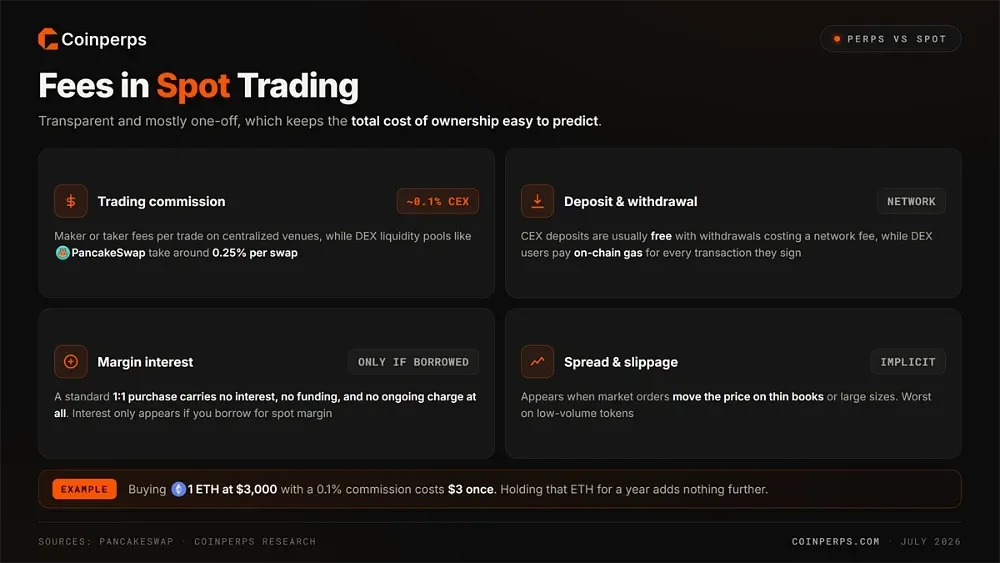
Spot fees are transparent and mostly one-off, which keeps the total cost of ownership easy to predict. The main line items are:
- Trading commission: Centralized exchanges charge roughly 0.1% per trade as maker or taker fees, while DEX liquidity pools like PancakeSwap take around 0.25% per swap.
- Deposit and withdrawal: CEX deposits are usually free with withdrawals costing a network fee, while DEX users pay on-chain gas for every transaction they sign.
- Margin interest: Only relevant if you borrow for spot margin, since a standard 1:1 purchase carries no interest, no funding, and no ongoing charge at all.
- Spread and slippage: An implicit cost rather than a fee, appearing when market orders move the price on thin books or large sizes, worst on low-volume tokens.
Example: Buying 1 ETH at $3,000 with a 0.1% commission costs $3 once, and holding that ETH for a year adds nothing further.
Fees in Perpetual Trading
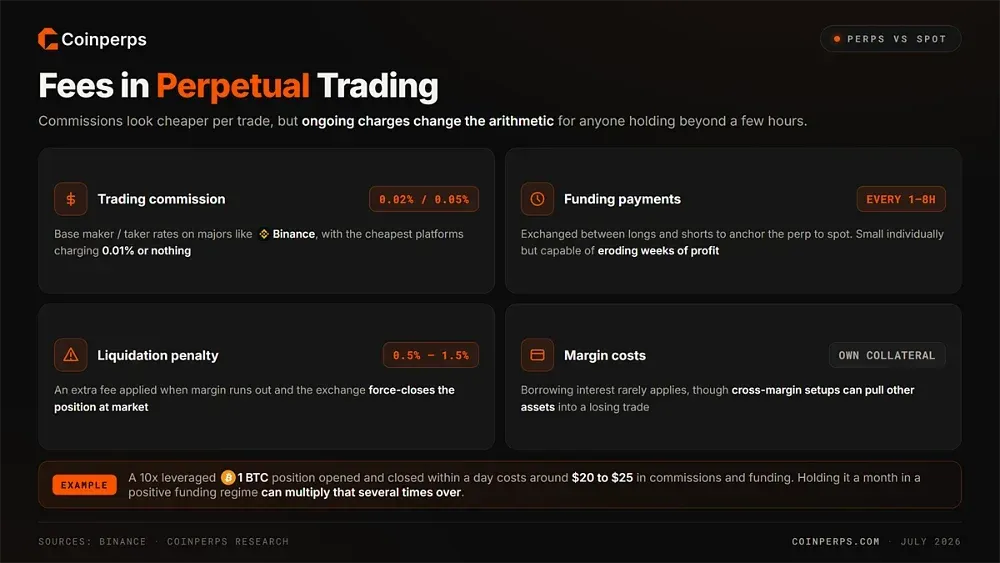
Perp commissions look cheaper per trade, but the ongoing charges change the arithmetic for anyone holding beyond a few hours. The costs that matter most are:
- Trading commission: Base rates on majors like Binance run near 0.02% maker and 0.05% taker, with the cheapest platforms in our lowest fee perpetual exchanges guide charging 0.01% or nothing.
- Funding payments: Exchanged between longs and shorts every one to eight hours to anchor the perp to spot, small individually but capable of eroding weeks of profit.
- Liquidation penalty: An extra fee of roughly 0.5% to 1.5% applied when your margin runs out and the exchange force-closes the position at market.
- Margin costs: Most perp positions use your own collateral, so borrowing interest rarely applies, though cross-margin setups can pull other assets into a losing trade.
Example: A 10x leveraged 1 BTC position opened and closed within a day might cost around $20 to $25 in commissions and funding combined, while holding it for a month in a positive funding regime could multiply that several times over.
Crypto Perps Leverage vs Spot Trading Margin
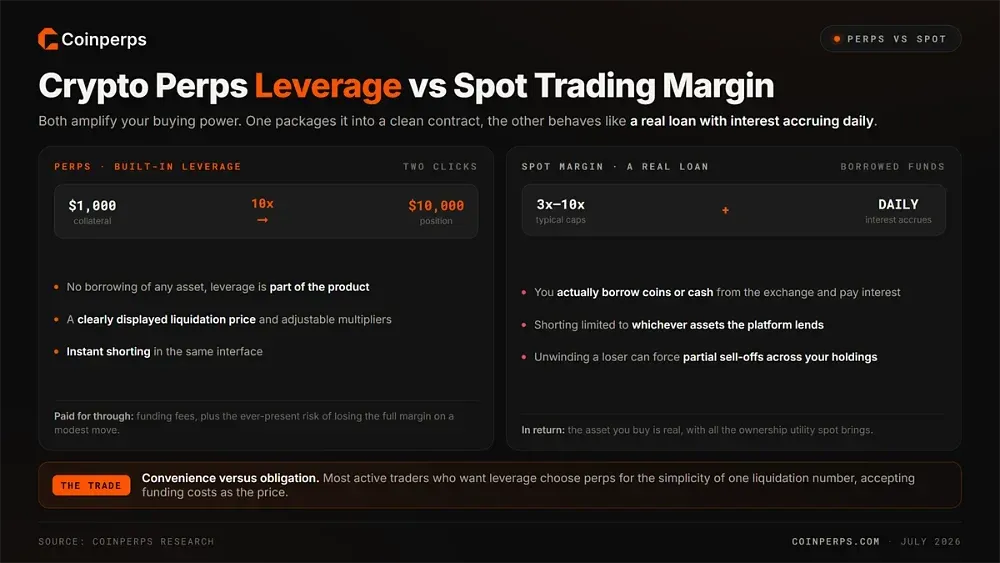
Perpetual exchanges build leverage directly into the product, letting you turn $1,000 of collateral into a $10,000 position in two clicks without borrowing any asset. You get a clearly displayed liquidation price, instant shorting, and adjustable multipliers, paid for through funding fees and the ever-present risk of losing the full margin on a modest move.
Spot margin works differently, since increasing your buying power means actually borrowing coins or cash from the exchange and paying interest on the loan. Leverage caps sit far lower, usually 3x to 10x, shorting is limited to whichever assets the platform lends, and unwinding a losing position can involve partial sell-offs across your holdings.
The practical distinction is convenience versus obligation. Perps package leverage into a single clean contract with one liquidation number to watch, while spot margin behaves like a real loan with interest accruing daily. Most active traders who want leverage choose perps for that simplicity, accepting funding costs as the price of it.
Perpetuals vs Spot Trading in DeFi
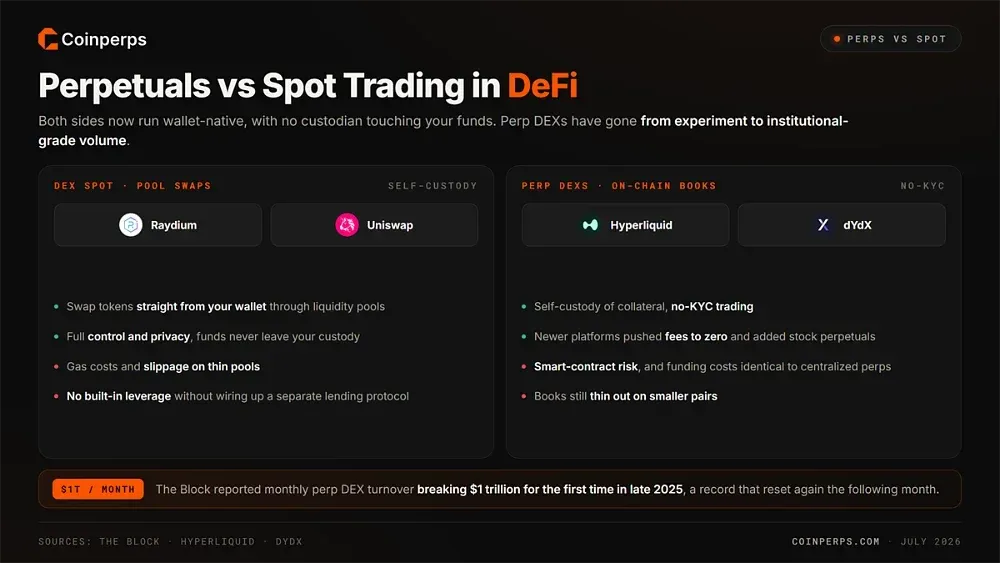
Spot trading on decentralized exchanges like Raydium means swapping tokens straight from your wallet through liquidity pools, with no custodian ever touching your funds. You keep full control and privacy, though you accept gas costs, occasional slippage on thin pools, and no built-in leverage without wiring up a separate lending protocol.
Decentralized perps have gone from experiment to serious market share. On-chain order books led by Hyperliquid and challengers like dYdX now process institutional-grade volume, and The Block reported monthly perp DEX turnover breaking $1 trillion for the first time in late 2025, a record that reset again the following month.
The appeal is no-KYC trading with self-custody of collateral, and newer platforms have pushed fees to zero and added stock perpetuals alongside crypto. The tradeoffs are smart-contract risk, funding costs identical to centralized perps, and books that still thin out on smaller pairs, a gap our perp DEX versus CEX comparison covers in depth.
Perpetual vs Spot Trading Risks
Both markets expose you to crypto's volatility, but perps layer leverage, funding, and forced closure on top, while spot's dangers concentrate in custody and asset selection. The two risk profiles deserve separate treatment, so we break them down individually below.
Risks in Perpetual Trading
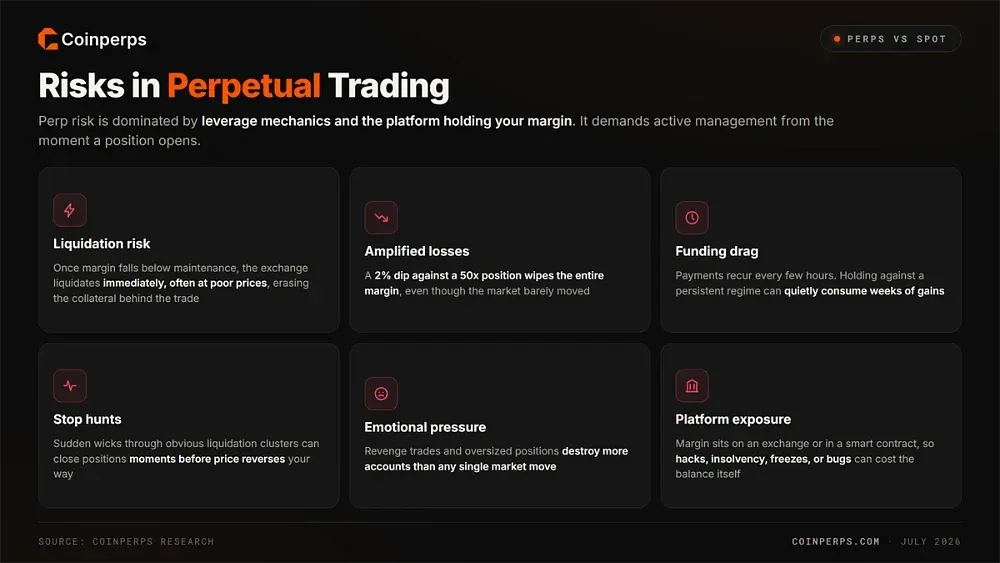
Perp risk is dominated by leverage mechanics and the platform holding your margin, and it demands active management from the moment a position opens.
The dangers to respect are:
- Liquidation risk: Once margin falls below maintenance requirements the exchange will liquidate your position immediately, often at poor prices, erasing the collateral behind the trade.
- Amplified losses: Leverage multiplies every adverse move, so a 2% dip against a 50x position wipes the entire margin even though the market barely moved.
- Funding drag: Payments exchanged between longs and shorts recur every few hours, and holding against a persistent funding regime can quietly consume weeks of gains.
- Stop hunts: Sudden wicks and manipulative sweeps through obvious liquidation clusters can close leveraged positions moments before price reverses in the direction you predicted.
- Emotional pressure: The speed and stakes of leveraged trading invite revenge trades and oversized positions, behavioural failures that destroy more accounts than any single market move.
- Platform exposure: Your margin sits on an exchange or inside a smart contract, so hacks, insolvency, withdrawal freezes, or contract bugs can cost you the balance itself.
Risks in Spot Trading
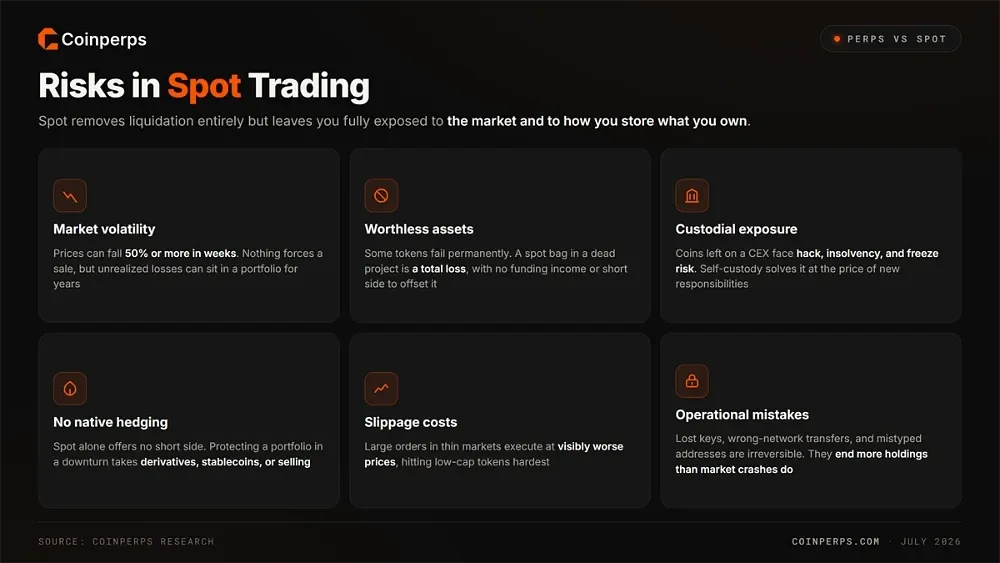
Spot removes liquidation entirely but leaves you fully exposed to the market and to how you store what you own.
The main vulnerabilities are:
- Market volatility: Prices can fall 50% or more in weeks, and although nothing forces you to sell, unrealized losses can sit in a portfolio for years.
- Worthless assets: Some tokens fail permanently, so a spot bag in a dead project becomes a total loss with no funding income or short side to offset it.
- Custodial exposure: Coins left on a centralized exchange face hack, insolvency, and withdrawal-freeze risk, which self-custody solves at the price of new responsibilities.
- No native hedging: Spot alone offers no short side, so protecting a portfolio in a downturn requires derivatives, stablecoins, or simply selling and waiting it out.
- Slippage costs: Large orders in thin markets execute at visibly worse prices, an implicit slippage cost that hits low-cap tokens hardest.
- Operational mistakes: Lost private keys, wrong-network transfers, and mistyped addresses are irreversible in crypto, and they end more holdings than market crashes do.
Tax Implications for Traders With Spot and Perps
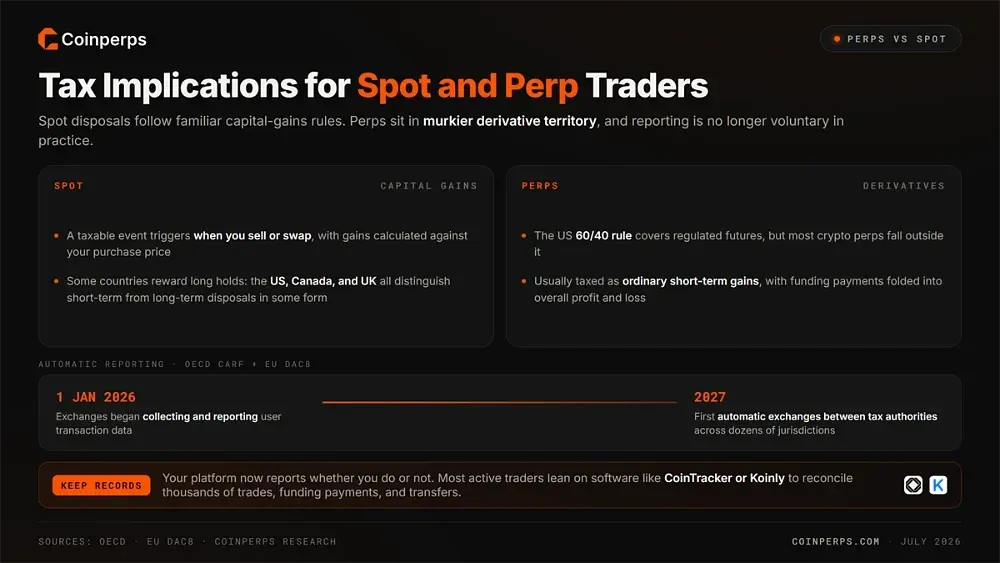
Spot trades typically trigger a taxable event when you sell or swap, with gains calculated against your purchase price and some countries rewarding long holding periods with reduced rates. The United States, Canada, and the United Kingdom all distinguish between short-term and long-term disposals in some form.
Perpetual contracts sit in murkier territory because they are derivatives. A few regimes offer specific treatment, such as the US 60/40 rule for regulated futures contracts, but most crypto perps fall outside it and get taxed as ordinary short-term gains, with funding payments folded into your overall profit and loss.
The bigger change is that reporting stopped being voluntary in practice. Under the OECD's Crypto-Asset Reporting Framework and the EU's DAC8 directive, exchanges began collecting and reporting user transaction data from 1 January 2026, with the first automatic exchanges between tax authorities landing in 2027 across dozens of jurisdictions.
That makes clean records non-negotiable for both spot and perp traders, since your platform now reports whether you do or not. Most active traders lean on software like CoinTracker or Koinly to reconcile thousands of trades, funding payments, and transfers into an accurate filing.
How to Choose Between Spot and Perpetual Trading
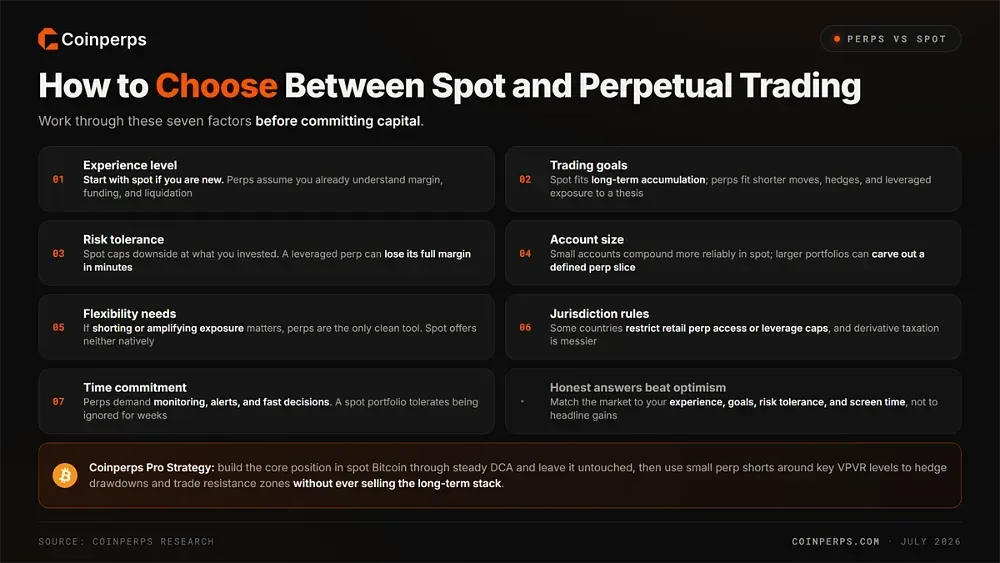
The right market depends on your experience, goals, risk tolerance, and how much time you can give the screen.
Work through these factors before committing capital:
- Experience level: Start with spot if you are new, since it teaches market behaviour without leverage, while perps assume you already understand margin, funding, and liquidation.
- Trading goals: Spot fits investors accumulating assets they believe in long term, while perps fit traders targeting shorter moves, hedges, or leveraged exposure to a thesis.
- Risk tolerance: Spot caps your downside at what you invested, but a leveraged perp can lose its full margin in minutes, so match position sizing honestly.
- Account size: Small accounts compound more reliably through spot, while larger portfolios can carve out a defined slice for perps without endangering core holdings.
- Flexibility needs: If shorting or amplifying exposure matters to your strategy, perps are the only clean tool, since spot offers neither natively.
- Jurisdiction rules: Some countries restrict retail perp access or leverage caps entirely, and derivative taxation is messier, so check your local rules before funding an account.
- Time commitment: Perps demand monitoring, alerts, and fast decisions, while a spot portfolio tolerates being ignored for weeks, so be honest about your availability.
Coinperps Pro Strategy: Build the core position in spot Bitcoin through steady DCA and leave it untouched, then use small perp shorts around key VPVR levels to hedge drawdowns and trade resistance zones without ever selling the long-term stack.
Bottom Line
Spot and perps are not competitors so much as different tools. One builds ownership of assets you can hold, stake, and move, while the other rents leveraged exposure by the hour, priced through funding and enforced by liquidation. Knowing which mechanics apply to your position matters more than any indicator.
Our honest guidance after years in both markets: earn your understanding in spot first, keep leverage small when you graduate to perps, and never let a funding rate or a liquidation price surprise you. The traders who last treat perps as a precision tool, not a lottery ticket.
Once both markets feel familiar, the natural next steps are inverse perpetuals, which settle in crypto rather than stablecoins, and crypto options, which add defined-risk ways to trade volatility that neither spot nor perpetual contracts can replicate on their own.
FAQs
